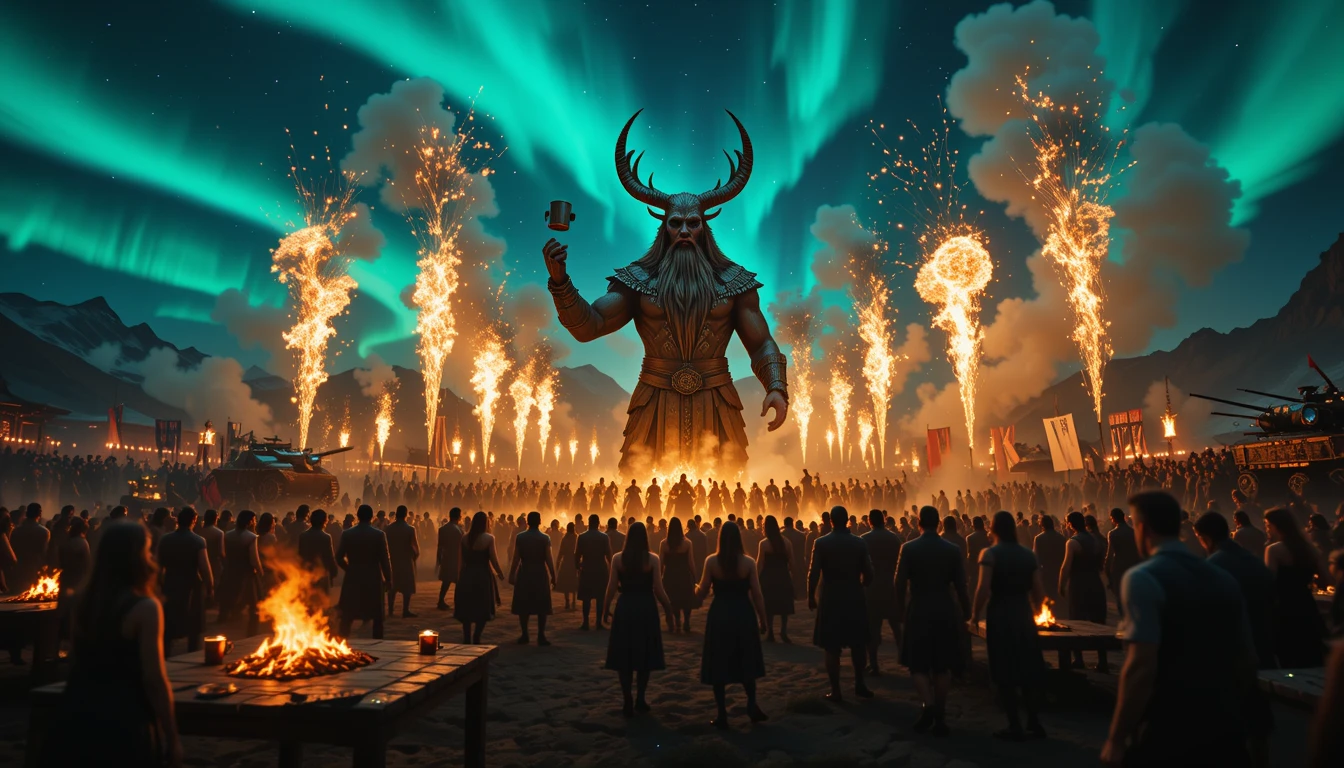
Viking Party Anthem Ignites a Night of Fire and Fury
Viking Anthem Ignites Fiery Revelry
A powerful Viking anthem sparks a night of wild celebration, fierce battles, and legendary revelry under a moonlit sky.
This article will explore a riveting Viking celebration where fiery passion meets ancient traditions. Discover how a thunderous anthem fuels a night of unbridled revelry, complete with roaring taverns, vigorous rituals, and legendary battle cries. Delve into the imagery, symbolism, and cultural motifs that elevate this Viking party into an unforgettable event.
🎯 The Intensity of a Viking Celebration
In the midst of an evening where time seems to halt and reality blurs with myth, the atmosphere is set ablaze by a celebration as fierce as it is liberating. Imagery leaps off the page from the vivid lyrics: “Raise your mugs. Let the alophone fly. The flames of the hearts kiss the starry sky.” Such words conjure a landscape where tradition meets raw emotion, where the clamor of raised voices echoes the fierce spirit of rebellion. The Viking revelry depicted here is not merely a party—it is a cultural performance steeped in energy, symbolism, and an unyielding call to experience life without restraint. A Viking celebration is a visceral reminder of a time when warriors mingled with poets under the guidance of myth and nature. Drawing from historical archives such as History Channel – Vikings and the detailed explorations available via Britannica – Vikings, the celebratory scene portrays a world where every thunderous stomp and jubilant cry is a thread connecting the present to legendary sagas.
This celebration is illustrated as a grand tapestry: imagine a setting where tables, usually reserved for quiet conversations and measured meals, transform into dancing platforms under an unyielding surge of energy. “Dance on tables, stomp the floor” is a recurring invitation that goes beyond a call to simply let loose—it is a deliberate act of defiance against the mundane. The phrase is a metaphor for shaking off the chains of everyday conformity, a vibrant summons to embrace life in its most exuberant form. In such moments, the typical restrictions of social etiquette are discarded as easily as worn-out armor in the heat of battle, inviting every soul to indulge, even if just for a fleeting night, in the raw intensity of celebration. The vivid transition from ceremonial formality to uninhibited movement finds roots in both historical ritual and modern expressions of personal freedom, echoing insights found through explorations at National Geographic – Viking Culture and The Metropolitan Museum of Art.
Hunched under an expansive starry sky, the imagery intensifies further with the auditory spectacle of synchronizing drums and clashing soundscapes—a symphony where each beat is as essential as a heartbeat. When the decree of “let the alophone fly” fills the air, the vibrations of ancient instruments seamlessly blend with the contemporary pulse of celebration. The approach is reminiscent of the continuous evolution seen in modern innovations and AI-driven advancements, where tradition and technology engage in a dynamic interplay; organizations like ScienceDirect have long documented how ancient practices can coalesce with modern methodologies. As the gathered Vikings move in tandem with the powerful rhythms, every stomp, every step on weathered wooden floors becomes a percussive homage to battle-hardened legacies. The spectacle is not merely an auditory delight but a sensory experience that embodies strategic rebellion—a moment where the individual’s spirit is reinvigorated by the collective intensity of shared passion and age-old honor.
Beyond the explicit declarations of rebel joy, the celebration is underpinned by an unspoken set of rituals that have evolved over centuries. The imagery of mugs raised in unity, their contents a symbol of life and valor, reminds one of historic feasts chronicled in medieval poems and sagas. Amidst this vibrant setting, the cultural significance of alcohol in forging bonds among comrades is well documented in studies available from Smithsonian Magazine – Vikings. These communal toasts resonate with a promise of reconnection to ancestral roots—a tradition that stands in stark contrast to modern corporate celebrations yet shares the same spirit of shared human experience and unity.
Tables, in this context, transcend their mundane functionality: they morph into the embodiments of freedom, becoming literal dance floors where inhibitions evaporate like mist in the warmth of dawn. The call to “dance on tables, stomp the floor” is both a literal and metaphorical liberation—a celebration where the structured restraint of everyday duties is abandoned in favor of raw, unfiltered exuberance. This transformation, where every table becomes a stage and each stomp reverberates like a rallying cry, offers parallels to breakthrough moments in business and technology. In contemporary environments, ideas often disrupt traditional frameworks, much as a Viking’s stomp shatters conventional limits. The parallel here is strikingly aligned with strategic paradigms discussed by innovators in forums such as Forbes – Revolutionary Trends and The New York Times – Cultural Shifts, which record how bursts of creativity often emerge from moments of collective abandon and audacity.
Synchronized drums and clashing soundscapes underpin this intensity, adding layers not only to the auditory but also the emotional tenor of the gathering. These rhythmic pulses are emblematic of Viking battles, where the beat of the drum was the cadence of life and death, a rhythmic ushering into the realm of mythic valor. In the modern era, the pulse of synchronized sound has also come to symbolize collective action and dynamic collaboration—a concept widely explored and celebrated in leadership studies available from platforms like Harvard Business Review. Each hit on the drum is a reminder that the power of unity lies in moving harmoniously despite individual differences, a philosophy that has inspired countless movements both in traditional arts and in the tech-driven innovational spirit found at venues like Viking Culture – Rogue Viking.
Delving deeper, the celebration also mirrors a synergistic confluence between the past and the present, inviting contemporary spectators to witness how timeless rituals can spark modern enthusiasm. The very act of letting the alophone fly and “raising your mugs” transforms into a dual metaphor—a salute to both the enduring legacy of ancient traditions and the transformative power inherent in shared experiences. It is a reminder that human connectivity transcends temporal boundaries, crafting experiences that are as powerful today as they were in the dawn of civilization. This bridging of ancient and modern is akin to how technological innovations, particularly in the arena of AI and automation, invite society to reimagine everyday experiences. For further insights on the integration of tradition and technology, one might explore the works summarized by Nordic Museum and detailed discussions on AI’s impact at Forbes.
🚀 Symbols of Viking Heritage and Rituals
At the heart of every Viking celebration lies a tapestry of symbols that are as profound as they are enterprising. The vivid directive to “pour the meat. Let it fill the horn” conjures images of a ritual steeped in both nourishment and myth. This imagery is layered with historical significance: the horn, traditionally a symbol of plenty and prosperity, serves as a vessel through which the collective spirit of the gathering is shared. In Viking culture, as documented by resources like Ancient Origins – Viking Mythology, feasting was not merely about sustenance but a form of communion where life, death, and destiny were interwoven. Pouring meat into horns becomes an allegory for distributing strength and solidarity among kin, a practice that was believed to invoke the blessings of the gods. Such rites were integral to ensuring that the legacy of battles fought, and challenges overcome, remained ever-present in the hearts of the warriors.
This rich symbolism brings to the fore another key reference—the evocative mention of “Odin’s beard.” Odin, the Allfather in Norse mythology, is a constant reminder of the sacrifices and valor embedded in the Viking ethos. His beard, a metaphor for wisdom and experience, bridges the mortal realm with the divine. The lyrical evocation of Odin’s beard serves not only to honor mythic heritage but also to remind celebrants that amid the riotous festivities, there exists a solemn remembrance of ancestral battles and epic legends. It is a shocking twist that juxtaposes the wild, unfettered joy of the celebration against the quiet backdrop of historical remembrance—a duality that embodies the essence of the Viking spirit.
Exploring these symbolic references reveals the depth of Viking rituals. The act of pouring meat into horns is a tangible expression of a culture that seamlessly integrates physical embodiment with mythic storytelling. This practice has been examined in detail by scholars through cultural studies such as those accessed via Viking Ship Museum and supported by academic discourses available at ScienceDirect – Viking Studies. Both sources highlight that the symbolic pouring of meat is less about the literal act and more about reinforcing bonds among warriors, celebrating their shared journey, and invoking a sense of belonging that transcends individualistic pursuits.
Furthermore, this ritual carries an important modern lesson. In today’s fast-paced world, symbolic gestures—whether in corporate cultures or community gatherings—serve as powerful tools to build unity and reinforce shared values. The Viking tradition, with its evocative symbology, parallels how modern organizations employ rituals and traditions to foster loyalty and communal strength. The alignment between historic rituals and contemporary practices can be explored further by examining insights on cultural psychology provided by Psychology Today and case studies on effective corporate rituals featured on Harvard Business Review.
The duality embedded in the Viking spirit is striking. On one hand, the celebration radiates exuberance and living-for-the-moment dynamics that evoke unbridled joy. On the other, it is interlaced with the gravity of remembrance—a nod to the valiant struggles and timeless legends of old. This duality not only situates the Viking ethos within a framework of historical continuity but also accentuates the importance of balancing ferocity with reflection. Orchestrated motions such as clashing soundscapes and synchronized drums mirror not only the heartbeat of war but also the rhythmic cadence of life, echoing the lifecycle of creation and destruction. Such themes are not lost on modern strategic thinkers who assess the necessity of balance in dynamic systems, as highlighted in readings from Encyclopedia Britannica and the reflective compositions of Farnam Street.
Moreover, the ceremonial use of tanks and instruments in the celebration introduces an intriguing fusion of the archaic with the avant-garde. The literal “flashing of tanks” and their reverberating booms transcend mere decoration; they symbolically represent the harnessing of modern technique to amplify traditional spirit. This blending echoes the broader role of emerging technology in contemporary society, where innovation breathes new life into established practices. Just as the integration of AI in various industries redefines operational efficiency and creative expression, so too does the Viking celebration meld traditional instruments with novel symbols to iterate and improvise on ancient rituals. Such cross-generational dialogue can be further examined in technological retrospectives available at TechCrunch and discussed in strategic reviews by The Wall Street Journal.
In summary, the symbols of Viking heritage and rituals serve as a reminder of an era defined by both its boundless intensity and its enduring respect for history. The pouring of meat into horns and the mention of Odin’s beard are not mere lyrical flourishes but carefully chosen elements that anchor the celebration in layers of meaning. They evoke a sense of camaraderie that is both fierce and tender, urging each attendee to remember that even in the throes of relentless revelry, there is profound strength in unity and remembrance.
🧠 The Anthem as a Rallying Cry for Unity
Few cultural artifacts carry the power to unite as relentlessly as the anthem of a Viking celebration. The recurring refrain—”Dance on tables, stomp the floor. Sing so loud they’ll hear next door”—serves as both an incantation and a collective call to arms. The anthem transcends the boundaries of a simple song; it is an expertly composed ritual that galvanizes disparate individuals into a single, cohesive force. Through its repeated verses, the anthem reinforces values of freedom, rebellion, and communal solidarity. The energy embedded within its cadence is reminiscent of the power of modern collaborative movements documented in articles by Forbes on cultural dynamics and the synergistic strategies outlined by The New York Times on uniting bold ideas.
In examining the anthem’s structure, it becomes clear that every element plays a role in its unifying power. The initial verses—”Raise your mugs. Let the alophone fly.”—invite individuals to relinquish personal reservations and join a shared journey of exhilaration. As the night deepens, the refrain “Dance on tables, stomp the floor” not only demands participation in an almost ritualistic celebration but serves as a metaphor for unifying diverse voices under a single, resonant beat. Strategic analysis, such as that found in the works of Harvard Business Review, often highlights the importance of a shared mission—a concept that finds its echo in the chorus of this ancient anthem.
Harmonious elements like the intensifying fiddles that give way to the explosive sounds of bursting barrels illustrate a musical progression that mirrors the journey from contemplation to full-throttle action. Just as companies today value transformative moments when innovation converges with execution, the anthem channels this very dynamic. Early segments of the song build anticipation, much as the initial stages of an exciting collaboration or startup venture meticulously set the stage for a breakthrough. Later, the song erupts with a ferocious energy, analogous to a product launch or a market disruption—a moment when the collective passion of many coalesces into a palpable force for change. Explorations on the transformative power of music and collective action, such as those found on Rolling Stone, emphasize that the resonance of a well-crafted anthem can alter the very fabric of society.
Further, the anthem’s design not only galvanizes the crowd during its performance but leaves behind an indelible mark on their psyche. The repeating refrain does more than command participation; it etches a memory of rebellious unity that lingers long after the final note fades. As highlighted by studies on ritual and memory in Psychology Today, repetitive musical motifs have a profound impact on the human brain’s associative processes. When each table is transformed into a stage for dance and every stomp vibrates with the echoes of shared experience, the anthem functions as a sonic signature of identity—a unifying call that reaffirms social bonds and inspires future gatherings.
Delving into the musical progression within the anthem reveals a meticulous layering of sound—a deliberate orchestration that parallels complex orchestral compositions in modern film scores. The song embarks on a journey where soft strains of fiddles gradually give way to the robust boom of percussion, culminating in the frantic crescendo of clashing soundscapes and roaring barrels. This sequential buildup of tension and release is not random; it mimics natural processes of anticipation and satisfaction that have been documented not only in musical theory but also in psychological studies on group dynamics. Research available on platforms like National Geographic underscores that such layered experiences create a potent psychological cocktail—one capable of inciting collective euphoria and fostering a deep sense of belonging.
The transformation triggered by the anthem is a journey from simple festivity to transformative cultural expression. In the early moments of the song, the ambiance is nearly hypnotic—a subtle merging of individual yearnings into a communal desire for liberation. As the refrain rings out for yet another round of ecstatic celebration, it is reminiscent of the relentless drive seen in major social movements, where a simple phrase becomes an emblem of collective consciousness. Analogous to how modern anthems or rallying cries have mobilized societal change, the Viking anthem acts as a beacon for unity. In contemporary narratives discussed on platforms like Viking Culture – Rogue Viking, collective vocalization is seen as a transformative force that mobilizes and inspires, reminding communities of their shared heritage and collective strength.
Another compelling attribute of the anthem is its ability to bridge generational divides. While the inspiration is deeply rooted in ancient legend and the pioneering spirit of Viking warriors, the underlying message of unity, resilience, and the pursuit of unbounded freedom is timeless. In today’s fast-evolving landscape, where technology and tradition increasingly merge, the Viking anthem offers a powerful reminder that every generation inherits both challenges and the opportunity to redefine joy. This sentiment is echoed across numerous strategic analyses found on platforms like The Wall Street Journal and in cultural retrospectives published by Smithsonian Magazine. The timeless appeal of such a rallying cry is the perfect study in how history and myth can mobilize present-day communities to break free of constraints and forge ahead with renewed vigor.
At its core, the anthem remains a celebration of life—a potent blend of fierce celebration and heartfelt unity that radiates through every line and note. It is a sonic rallying cry that not only resonates with the memories of ancient battles but also inspires modern-day warriors in fields as diverse as technology, art, and entrepreneurship. The strategic potency of this hymn lies in its ability to unify while igniting passion, challenging every listener to not only take part in the revelry but also to carry the embers of communal strength into the challenges of daily life. This transformative power is frequently discussed in leadership discourses available at Harvard Business Review, where the capacity for music and shared narrative to unify disparate groups is celebrated as a fundamental human strength.
In closing this exploration of the anthem, it is pertinent to recognize that its legacy is far from fleeting. As the celebratory fire dims and the embers fade ever so slightly, the memory of that fierce night—the thunderous stomps, the jubilant chants, the unified voices reaching out to claim the darkness—is permanently etched into the collective consciousness. It stands as a promise that as long as there is a shared desire for unity and a drive to rebel against the mundane, the spirit of the Viking celebration will continue to inspire. For those interested in further exploring the power of narrative and ritual in building community, academic insights and historical narratives can be further enriched by resources such as Viking Ship Museum and thorough analyses available at Ancient Origins.
To encapsulate the transformative power of this anthem, it must be understood not just as a call to revelry but as an enduring symbol of unity, a musical embodiment of the mingling of ancient valor and modern resilience. In a world that often seems divided, such cultural artifacts remind society of the deeper ties that bind individuals together through shared narratives, mutual respect, and an everlasting hunger for freedom.
Beyond the immediate sensory impact, the Viking anthem—and by extension, the entire celebration—serves as a modern allegory. It challenges contemporary audiences to consider how elements of the past, though shrouded in myth, can inspire cutting-edge innovation and a renewed appreciation for heritage. Just as AI and automation are redefining productivity and innovation in the modern era, these ancient practices encourage a fusion of tradition and transformation. Modern enterprises and cultural institutions alike have much to learn from the meticulously crafted unity in these celebratory rituals. From the energetic “flash the tanks” moments that fuse modern spectacle with historic roots to the resonant, ritualistic call to “sing so loud they’ll hear next door,” every element of the Viking celebration is a study in the art of communal transformation—an art that continues to reinvigorate both ancient traditions and contemporary organizational cultures. Observations and parallels can be studied further in business strategy analyses on platforms like The Wall Street Journal, which frequently draw on historical analogies to describe modern dynamics.
Ultimately, the vibrant tapestry of the Viking celebration, with its layers of symbolic rituals, unifying anthems, and a palpable atmosphere of boundless energy, offers more than just a description of a bygone era. It is a blueprint for harnessing human spirit—a call to embrace life’s dualities, to honor the weight of history while forging ahead with unrelenting determination and creativity. For modern innovators, leaders, and enthusiasts alike, the lessons of this ancient revelry are both inspiring and instructive. They illustrate that the pursuit of joy and unity requires both awe and action—a recognition that while the past offers profound wisdom, it is the present, rife with possibility and fueled by collective will, in which to build a future reminiscent of legendary nights under starry skies. For further exploration into the intersection of tradition and innovation, one might delve into discussions shared by TechCrunch and reflective pieces available on Viking Culture – Rogue Viking.
By weaving together the intensity of celebration, the profound symbols of heritage, and the rousing call of anthems that bridge generations, this exploration of Viking revelry stands as a testament to the enduring power of communal celebration. It is a narrative that beckons every modern individual to find a resonance within their own life—whether that be through technological innovation, creative expression, or the simple, timeless act of coming together to experience something larger than the sum of its parts.
In a vibrant world that constantly shifts in pace and technology, the essence of such celebrations remains a guiding beacon. It is a reminder that behind every digital advancement, every algorithm-driven success, lies a heart that yearns for connection, rebellion, and meaning—a soul that echoes with the resounding call: “This is the night for Vikings to sing.” Ultimately, the story of the Viking celebration is a living allegory for any era, echoing the eternal truth that in uniting diverse voices and harnessing the sheer intensity of shared passion, there is an unmatched power to reshape the world.
This multifaceted exploration, grounded in the vivid imagery of raised mugs, clashing rhythms, and a storied past, feeds into larger narratives about the importance of cultural memory and innovation. Whether viewed from the lens of ancient ritual or modern business strategy, the Viking celebration offers rich insights into the transformative power of communal energy. For readers interested in further delving into these themes, additional perspectives can be gained from the detailed historical accounts on History Channel – Vikings, scholarly articles on ScienceDirect, and cultural chronicles provided by Nordic Museum.
The exploration of Viking celebration is an invitation to reimagine the interplay between tradition and modernity—a dialogue that continues to inspire not only the cultural custodians of yesterday but also the digital innovators and creative thinkers of today. The Viking spirit, with its profound call to dance on tables, to stomp fiercely and to celebrate life with all its complexities, serves as a timeless model of unity and passion that transcends the passage of time. It calls upon every modern institution, every innovative venture, and every individual to harness that raw, unbridled intensity in the pursuit of a lively, connected, and ever-evolving future.
As the echoes of the Viking song reverberate across the corridors of time, the modern world is reminded that every moment of collective celebration—every rhythmic heartbeat shared in unison—is a testament to the enduring strength of the human spirit. It is a clarion call to embrace the present with unyielding vigor, drawing from the reservoir of ancient traditions while daring to innovate boldly. For those who seek to capture the spirit of true innovation and transformative culture, the lessons from this ancient celebration offer a powerful roadmap: to live, to rebel, and above all, to connect deeply with the pulse of life.
Such a legacy illustrates the enduring value of harnessing both historical wisdom and cutting-edge creativity. It is a transcendent muse for those who believe that even amidst rapid technological transformations, the human need for unity and communal expression remains universal. Therefore, whether viewed as a dynamic cultural phenomenon or as a strategic model for unity and innovation, the Viking celebration stands as an eternal testament to the power of shared passions and the limitless potential that emerges when ancient reverie intersects with modern ambition.
In closing, the panoramic view of this celebratory exploration serves as a dynamic treatise on the convergence of cultural heritage and modern dynamism. It offers a blueprint for harnessing nostalgic intensity while navigating contemporary challenges—a narrative enriched by every raised mug, every stomp on the floor, and every resonant note of a song that dares to defy the ordinary. Through this lens, the Viking celebration becomes more than an ode to the past; it transforms into an influential blueprint that inspires today’s creative minds and strategic leaders, echoing the timeless truth that unity, when forged in the fire of shared experience, is a bridge to the future.
For those who wish to delve deeper into the transformative power of symbols and rituals within both historical and modern frameworks, additional research is available on Ancient Origins and comprehensive analyses of cultural unity can be found through Psychology Today. Similarly, insights on harnessing the raw intensity of collective inspiration are continuously explored in detailed expositions on Rolling Stone and The Wall Street Journal.
Embracing the full spectrum of this celebration’s intensity, symbolism, and unity not only honors the vivid legends of the past but also galvanizes contemporary innovation—with every stomp on the floor serving as a reminder that true transformation begins when communities rise together, echoing the ageless, inspiring call: “This is the night for Vikings to sing.”