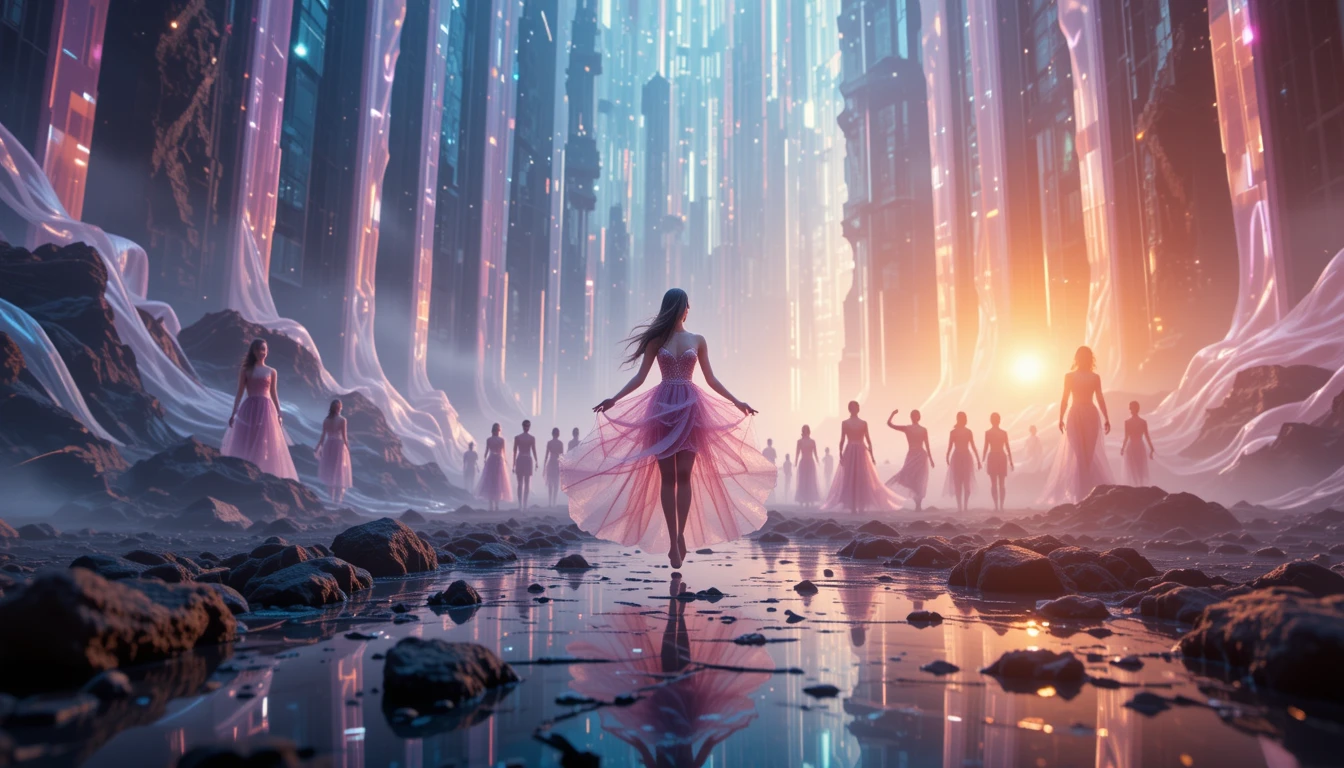
How AI Is Revolutionizing Music, Art, and Storytelling
AI’s Creative Revolution: Music, Art, and Storytelling Redefined
Explore how AI transforms music composition, digital art, and storytelling with innovative tools, ethical insights, and future trends in creativity.
This article delves into the transformative role of artificial intelligence in the creative landscape. It highlights how AI is redefining music composition, digital art production, and narrative creation. With innovative tools and emerging trends, the evolution of creativity driven by AI is explored alongside the ethical challenges involved. Discover how technology is intertwining with art to create new realms of expression and opportunity.
🎵 AI Transforming Music Creation
AI is quietly orchestrating a revolution, fundamentally changing how new music emerges into the world. Much like a skilled apprentice studying under musical geniuses, AI-driven composition deeply analyzes existing music to master chord progressions, harmonies, and melodic structures, deriving its own original compositions. By closely mimicking the creative process of seasoned musicians, AI takes music composition to astonishing new heights.
AI music generators today, such as MuseNet by OpenAI, Google’s Magenta, and AIVA (Artificial Intelligence Virtual Artist), help demystify the intricacies behind music generation, enabling the creation of rich, original pieces across several genres. MuseNet, in particular, is capable of harmonizing diverse musical styles, effortlessly crafting digital symphonies ranging from classical to jazz. Meanwhile, AIVA specializes in composing immersive film scores and intuitive game soundtracks, painting sonic landscapes that offer deeply impactful experiences.
Real-world applications of AI-generated music have pervaded diverse creative sectors. The entertainment industry leans heavily on AI’s precision and speed in generating background music tailored to evoke specific emotions for films and trailers. Advertisements increasingly leverage AI-generated jingles, too, since these customized compositions can easily capture consumer attention. Similarly, gaming developers utilize AI to dynamically compose score variations, adapting to real-time interactions with gamers.
One particularly intuitive space where AI flourishes is streaming platforms like Spotify, providing listeners with tailored playlists finely attuned to their individual preferences. Tremendous databases of musical patterns allow AI models to offer hyper-personalized tunes. Thus, users consistently discover exciting new artists and genres matched directly to their tastes—a win-win for listeners and creators alike.
These advancements aren’t designed to eliminate human participation but rather facilitate unprecedented sonic experimentation. By quickly generating countless new musical possibilities, AI turns musicians into prolific explorers of sound. Artists leverage AI to enrich their creative expression, pursue fresh ideas, and even break through longstanding creative blocks. Through the fusion of algorithmic precision and human vision, entirely novel musical territories emerge regularly, underscoring a unique human-machine partnership on the creative frontier.
🎨 AI Generating Digital Art
What if artificial intelligence replaced the palettes and brushes of classic artists with pixels and deep-learning algorithms? AI’s capability to generate stunning digital art comes precisely from its detailed analysis of existing masterpieces, encapsulating centuries of creative genius. Deep learning systems scrutinize millions of artworks, profoundly grasping varied styles—everything from renaissance portraits to surreal compositions. AI’s neuronal networks subsequently leverage this vast historical knowledge to create original digital pieces appreciative of acclaimed artistic movements like impressionism, cubism, and modern abstract art.
Major breakthroughs in digital arts have come courtesy of pioneering AI art generators, most notably DALL-E by OpenAI, Google’s vivacious DeepDream, Runway ML, and StableDiffusion. DALL-E, for instance, transforms textual prompts into vivid visual narratives—prompt the AI with something absurdly imaginative such as “a futuristic cat astronaut,” and behold a creative artwork delivered smoothly. Meanwhile, DeepDream applies elaborate dreamlike effects to photographs, producing extraordinary surreal visuals, whereas Runway ML enables artists to experiment intuitively and freely, revolutionizing film visual effects.
AI’s visual creativity profoundly affects diverse industries, transforming their visual narratives. Logo developers harness AI’s insight to effortlessly experiment with compelling designs. Concept artists and animators employ AI-generated artistry to rapidly prototype imaginative characters, environments, and visual motifs. Even in unconventional realms like fashion and interior decoration, AI has introduced novel aesthetic trends and bespoke visualizations.
This sophistication perfectly complements rather than replaces human creativity. Artists apply AI as a powerful tool to push boundaries, quickly iterating and refining designs while inflecting them with intentional human judgment, intuition, and finesse. In doing so, unique collaborative compositions emerge, where AI’s precision meets the invaluable artistry of human taste and emotional connection.
📚 AI-Powered Storytelling and Content Generation
Humans have a deep-seated ability to immerse audiences in compelling narratives, a capability AI tapping into natural language processing (NLP) and iterative deep learning increasingly emulates. Contemporary AI writing tools analyze massive literary, journalistic, and conversational content pools, transforming thorough text pattern comprehension into meaningful generated articles, stories, copywriting, scripts, and poems.
A handful of highly distinguished AI tools lead the burgeoning domain of content generation. Chief among these industry influencers are ChatGPT, Jasper AI, and Pseudoite. ChatGPT quickly composed coherent blogs, creative stories, essays, and conversational scripts fueling interactive narratives. Jasper AI strategically powers thoughtful ad copy, captivating social media posts, and content marketing campaigns targeting specific consumer segments. For fiction authors grappling with writer’s block, Pseudoite facilitates innovative brainstorming through plot generation and detailed dialogue suggestions—creativity augmentation at its finest.
Professional sectors increasingly rely on AI’s unmatched ability to streamline writing processes and expedite content strategies. Newspapers and digital publications integrate AI text generators to automate news blurbs and descriptive articles swiftly. Filmmakers utilize AI-driven screenwriting assistance to conceptualize captivating scenes and dialogue, while marketers leverage AI’s analytic-driven prose to captivate buyers’ attention and drive optimized engagement.
Yet AI-generated content faces critical constraints: authenticity and emotional depth. While algorithms proficiently replicate grammar structure, style, tone, and communicative patterns, they inherently lack genuine sentiment or lived expertise. Human authors embed nuanced emotional layers, subjective perspectives, personal anecdotes, and culturally resonant themes—elements current AI models cannot authentically mimic nor generate spontaneously. Hence, despite enormous potential, authentic human storytelling will continue to remain a cornerstone of compelling narrative arts.
⚖️ Ethical Challenges and Future Perspectives in AI Creativity
The blend of AI technology with creativity isn’t without friction points. Ethical dilemmas surface particularly through intellectual property rights, raising complicated debates about originality, authentic creativity, and copyright concerns. When algos actively emulate centuries-worth of human-based artistic measures, including styles and forms, legal distinctions around ownership, authorization, and copyright inevitably become ambiguous.
Copyright law questions currently remain murky worldwide. AI-generated musical compositions, literary works, and digital art often closely resemble human-produced originals. Challenges intensify when jurisdictions disagree on creator attribution and protection provisions for autonomously AI-created content, complicating artistic legitimacy within legal frameworks.
Philosophically nuanced questions frequently accompany technological maturity: Can algorithms exhibit genuine originality, or do they merely imitate and replicate existing creativity? While certain AI creations display extraordinary innovation, many hold the perspective that AI fundamentally mimics thorough data comprehension of extant art, literature, and music rather than innovating in fundamentally original fashion.
Looking ahead into 2025 and beyond, a clear evolution emerges through enhanced human-AI collaborations, with increasing technological transparency and ethical AI-model training. AI won’t entirely replace artists or creators but rather act symbiotically, inspiring fresh avenues of artistic exploration and encouraging deeper experimentation across creative mediums. Furthermore, initiatives around ethical AI actively establish guidelines and standards ensuring responsible training and usage of AI, promoting equitable acknowledgment and proper data rights syndication.
Crucially, despite AI’s impressive contributions, it inevitably lacks essential human elements—personal experience, true empathy, and genuine intuition—that profoundly enrich authentic creativity. Thus, even as AI boldly reshapes creative arenas with precision, speed, and analytical depth, human originality, emotional resonance, and cultural authenticity remain irreplaceably central to genuinely meaningful art.