How AI Is Revolutionizing Music, Art, and Human Creativity
AI Impact on Art, Music & Human Creativity
Discover how AI is reshaping music, art, design, and creative collaboration while sparking a revolution in human creativity with innovative tools.
This article will explore the transformative role of AI in the creative world. It highlights how AI-driven platforms are not only composing music and generating art but are also revolutionizing design, collaboration, and creative workflows. With AI-powered tools enhancing human expression and streamlining technical tasks, the future of creativity is evolving into an intricate dance between man and machine.
🎯 ## 1. AI as a Creative Powerhouse
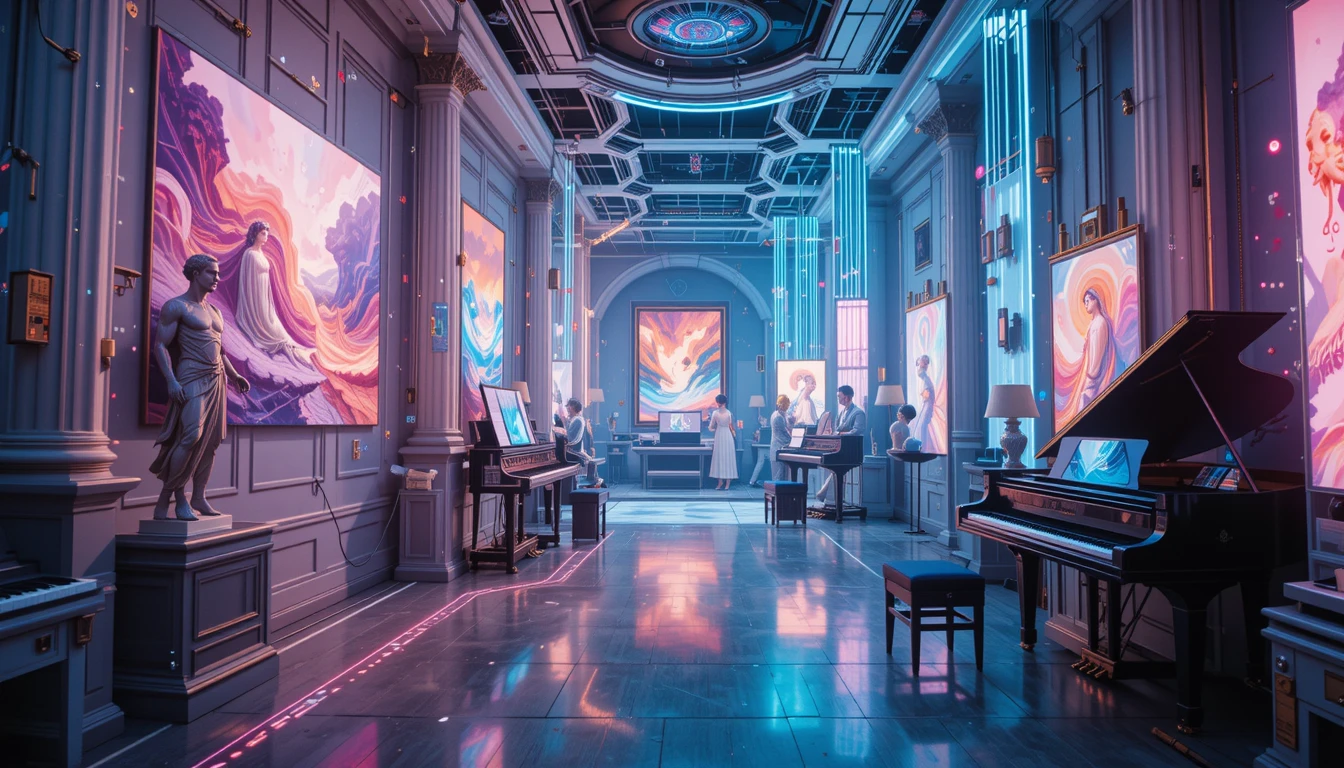
In a world where technology increasingly influences every facet of life, one cannot help but marvel at how artificial intelligence is reshaping art and music. Imagine a painter’s palette suddenly transformed into an infinite well of colors or a grand piano that not only plays notes but composes symphonies on demand. The merging of AI with creative processes is not a distant future concept—it’s unfolding right before our eyes. The fusion of algorithms and art is proving to be a catalyst for unprecedented creative expression, allowing innovative minds to breach traditional boundaries and democratizing creativity for everyone.
AI’s Foray into Music Creation
At the forefront of this creative revolution is AI’s role in reinventing the musical landscape. Platforms such as Google’s MusicLM are emblematic of this shift. MusicLM, trained on an enormous library of 280,000 hours of music, exemplifies how AI can absorb, analyze, and reinterpret the vast spectrum of human musical expression. By reading text descriptions—say, “a jazzy tune with a futuristic twist”—this AI transforms words into rich, layered soundscapes that blend genres and styles. This capability doesn’t merely mimic existing tracks; it births entirely new auditory experiences that challenge our notion of genre and composition. According to reports from Nature, the potential for AI-generated music to push creative boundaries is immense, and it stands as proof of how technology can elevate the arts.
Visual Art and AI-Driven Creativity
Just as AI has taken to the realm of music, it also paves new avenues for visual art. The translation of text descriptions into innovative visuals is a testament to AI’s dual role as both a technical tool and a creative partner. Platforms that can synthesize various artistic styles, applying nuances from classical art to modern abstract forms, echo the groundbreaking work seen with tools like DALL·E 2. Such systems process complex inputs and output artworks that challenge conventional wisdom about artistic creation. When a creator inputs a description that calls for a “fusion of Renaissance portraiture with futuristic neon aesthetics,” the AI harmonizes disparate influences to generate artwork that can feel both timeless and innovatively modern. This dynamic interplay has been celebrated in academic discussions at JSTOR, heralding a new era where tools empower individuals without formal artistic training to produce works of high creative value.
Democratizing the Creative Process
Historically, mastery of art and music was reserved for those who underwent rigorous formal training. Today, AI is leveling that playing field. With assistive technologies that offer intuitive interfaces and powerful analytical capabilities, individuals who might have once been hindered by technical limitations are now stepping confidently into the creative arena. AI tools are not replacing human creativity but are instead enhancing it, much like a brush augments a painter’s vision. Studies referenced by the Forbes Technology Council indicate that when collaborators integrate AI into their workflow, there is an approximate 25% boost in creative productivity. This enhancement means that creative teams can focus on the higher-level vision while the AI handles routine tasks, such as generating multiple variations of musical notes or artistic elements. It’s akin to having a tireless assistant who can bring to life any creative notion, making it a potent tool for both professionals and amateurs alike.
Real-World Impact on Creative Productivity
The tangible impact of AI in creative fields is underscored by compelling statistics. For instance, research has shown that the perceived value of art can increase by as much as 50% when AI is incorporated intelligently into the creative process. This boost is not merely subjective; it is supported by robust data from various creative industries including architecture, interior design, and filmmaking. The advent of AI as a creative powerhouse is transforming how art is produced, interpreted, and valued. When the precision of algorithms meets the nuance of human emotion, the outcome is a vibrant symbiosis that enriches our cultural tapestry. Resources from MIT Technology Review provide in-depth analysis into these transformative effects and how they are reshaping artistic careers across the globe.
A noteworthy example is an architect who partnered with an AI system—it was reportedly able to generate 500 design ideas in just five hours, a feat that would be infeasible through traditional methods. Such breakthroughs illustrate AI’s prowess in not only accelerating the process but also in expanding the scope of what can be imagined and executed. This phenomenon mirrors the age-old evolution of tools that have historically amplified human potential, from the invention of the printing press to the advent of digital design software.
The underpinning force in these developments is clear: AI is more than a mere tool—it is an enabler of creative expression. The integration of these technologies does not diminish the role of the artist; rather, it expands the borders of possibility, enabling creators to navigate and merge multiple artistic realms in ways that were once the stuff of science fiction. For more insights on how technology is continually boosting creative potential, see the Wired reports which delve deep into the impact of AI on the creative alchemy.
🚀 ## 2. Enhancing Collaboration and Workflow in Creative Industries
The second major transformation AI brings to the creative ecosystem is its profound impact on collaboration and workflow efficiency. In a time where global connectivity is the norm, the importance of seamless teamwork cannot be overstated. AI-powered platforms have become the new sinew in the muscles of creative industries, enabling fluid communication across continents and vastly reducing the time it takes to move from brainstorming to final execution.
AI as the Catalyst for Global Creative Collaboration
Imagine a musician in London collaborating in real time with a vocalist in Tokyo, all mediated by an AI system that synchronizes their ideas, moods, and timing. This is not the work of a futuristic novel; it is an emerging reality powered by technologies that facilitate real-time, cross-continental creative exchanges. According to research published by IBM Cloud, AI systems can break down language, cultural, and geographical barriers, enabling creative professionals to meld ideas seamlessly irrespective of their physical location. These platforms allow users to input their distinctive styles and preferences, ensuring that the unique human touch is preserved while still reaping the benefits of rapid, algorithm-driven ideation.
Streamlining Workflows with AI– A Case Study Approach
One of the most striking examples of AI-enhanced efficiency comes from the design world. Using AI platforms like Midjourney, creative teams have reported generating as many as 500 design ideas in five hours for projects such as 3D-printed clothing designs. Such an acceleration in the creative process is akin to having an unlimited brainstorming session where every conceivable idea is produced on demand. This capacity to churn out multiple compositions rapidly allows creative teams to iterate far more quickly than ever before. It is a dramatic shift from traditional methods where generating even a handful of ideas could take days or weeks.
In the complex worlds of interior design, architecture, and filmmaking, AI systems are streamlining workflows by handling repetitive tasks, coordinating timelines, and even predicting project bottlenecks before they occur. For interior designers, this means generating hundreds of layout possibilities and visualizations in near real-time, thus significantly reducing the time spent on initial concept development. Architects, by contrast, leverage AI to optimize materials, energy efficiency, and design aesthetics concurrently—an integration of technical prowess and creative vision that is echoed in research by the ArchDaily collective of architects worldwide.
Enhancing Team Creativity Through AI-Assisted Brainstorming
The role of AI in elevating brainstorming sessions cannot be overstated. Traditional creative sessions often involve long, laborious efforts to sketch out ideas and iterate on multiple drafts. With AI, this process is supercharged to a hyper-efficient model. It transforms initial sketches and ideas into refined concepts, allowing creative teams to explore a broader spectrum of possibilities. Studies have shown that by offloading the routine aspects of design and ideation to AI, teams report an enhanced overall creative output and a greater sense of satisfaction with their final products. A report from Harvard Business Review outlines how this transformation drives efficiency while preserving the essential human element of creativity.
This collaboration between human and machine is comparable to a well-conducted orchestra. In this analogy, human creativity and spontaneity complement the consistent, rapid-fire capabilities of AI. The conductor—here symbolizing project leads and creative directors—guides this ensemble, ensuring every element from AI-generated concepts to manually crafted details is harmoniously integrated. For more on collaborative creative tools, the Adobe Creative Cloud offers an array of solutions that are already setting industry standards.
Real-World Examples of AI-Enhanced Workflow
Concrete examples from various industries underscore this collaboration-driven revolution. In filmmaking, AI is playing a transformative role—from helping with real-time script editing to enhancing visual effects that make digital characters appear lifelike. Advanced editing platforms incorporate AI to suggest cuts, transitions, and even music scores that match the emotional tone of a scene. These tools are making high-end production more accessible while elevating the creative quality of independent projects. The Variety magazine frequently highlights how directors and editors use AI to overcome traditional constraints in production.
In architecture, the integration of AI facilitates the challenging task of designing buildings that are not only aesthetically pleasing but also sustainable and energy-efficient. AI-driven simulations analyze countless design variables, ensuring that final structures optimize both form and function. For instance, collaborations between architects and AI platforms have already led to innovations in constructing eco-friendly buildings, as documented by Dezeen.
Within the realm of music, AI-powered platforms are becoming like personalized DJs—curating playlists, generating music in real time based on biofeedback, and even acting as collaborative partners during live jam sessions. This integration of AI into the creative process not only enhances the output quality but also opens new avenues for interactive and immersive experiences. Enthusiastic perspectives on these developments can further be explored in publications by Rolling Stone, which examines how technology is reshaping musical performance and production.
Bullet Points: Key Benefits of AI in Collaboration and Workflow
- Improved Efficiency: AI handles repetitive tasks, leaving more time for high-level creative thinking and innovation.
- Real-Time Cross-Continental Exchange: Global collaborations become seamless, allowing for an instantaneous flow of ideas.
- Enhanced Visualization: Rapid generation of design ideas that assist in quicker approvals and concept refinements.
- Flexible Customization: Adaptive AI platforms tailor outputs to match the creative preferences and styles of each team member.
By redefining the parameters of traditional creative workflows, AI is not only a force multiplier for efficiency but also a bridge that connects diverse creative disciplines. The synergy of human ingenuity and digital prowess ensures that the creative output is not compromised but significantly enriched. For further reading on the transformative impact of AI on workflow enhancements, trusted sources like McKinsey Insights provide in-depth analyses and forecasts.
🧠 ## 3. Ethical, Legal, and Creative Implications of AI Integration
While the creative infusion of AI is undeniably transformative, it is not without its complexities. The relentless pace of technological innovation brings with it a host of ethical, legal, and creative challenges. These concerns provoke a critical discussion about the future of human creativity—a debate where technology serves as both a partner and a provocateur, challenging long-held perceptions of art, authorship, and originality.
The Issue of Homogenization
One of the chief worries about widespread AI adoption in creative fields is the risk of homogenization. If every artist and creative professional begins to rely on the same powerful AI tools, will the resulting art start to converge into a uniform aesthetic that lacks distinctiveness? Critics argue that when design suggestions and artistic inputs are generated by similar underlying algorithms, the unique voice of the artist could be drowned out, leading to a world of art that feels generic. A study on AI-generated literature, as discussed in academic circles at ScienceDirect, reveals that while efficiency and volume increase, there often is a noticeable absence of the nuanced style characteristic of human authors. This is a red flag for communities dedicated to preserving diversity in artistic expression.
Ethical Data Usage and Algorithmic Bias
Closely linked to the issue of homogenization is the potential for bias in AI algorithms. AI systems are, by their nature, reflections of the data on which they are trained. If the training data is biased or incomplete, the output will likely mirror these limitations. This introduces serious ethical concerns about diversity and representation in the arts. When AI is trained on predominantly Western art or music, for example, it might inadvertently marginalize or misinterpret cultural nuances from other parts of the world. Research published by the Association for Computing Machinery (ACM) emphasizes that addressing data bias is critical to ensuring equitable creative outputs. It is essential that developers remain vigilant—continuously auditing training data and refining algorithms—to guarantee that AI tools empower diverse creative expressions rather than limiting them.
Legal Complexities: Copyright, Ownership, and Authorship
As AI becomes an integral part of the creative process, new legal questions inevitably arise. Who, for instance, retains copyright over a piece that is the product of both human imagination and AI computation? This gray area extends to issues of ownership and intellectual property rights. Traditional legal frameworks are based on the premise of human authorship, and regulating co-created works poses unique challenges. Publications from Harvard Law Review have already begun addressing these intricate questions, suggesting that our definitions of creativity and authorship may need to evolve alongside technological advancement. This conundrum is not merely academic—real-world disputes about ownership of AI-generated music and artwork are unfolding, urging legal systems to adapt quickly. The ongoing debate is further enriched by discussions in tech policy journals and articles at Brookings Institution, where scholars propose frameworks that recognize both human and machine contributions.
Redefining Creative Roles in the AI Era
Perhaps one of the most exhilarating aspects of AI integration is the arrival of new creative roles and collaboration models. Far from being a replacement for human creativity, AI is emerging as a true partner—a catalyst that frees the mind from mundane tasks and opens up possibilities for unprecedented innovation. This paradigm shift is reflected in job market trends, where roles such as AI art directors, AI music producers, and creative technologists are starting to appear across industries. These new positions recognize that while AI excels at handling repetitive and technical functions, human creators continue to be indispensable for crafting the emotional and narrative dimensions of art. Insights from Cognizant underscore how these hybrid roles blend technical expertise with creative vision, ensuring that both aspects flourish in tandem.
Future Possibilities: A Merged Creative Frontier
The frontier of creative expression is about to be redefined as AI and human creativity merge more seamlessly. Imagine a future where collaborative sessions extend beyond mere brainstorming to become true dialogues between human intuition and machine precision. In this envisioned realm, AI would not just execute commands but actively participate as a creative partner—suggesting, refining, and even challenging the human creator to push the boundaries further. This convergence offers the promise of new art forms and immersive experiences that blend virtual and physical realities. For a deeper look at future trends in digital creativity, the Forbes Tech Council frequently publishes thought-provoking articles on the intersection of technology and art.
Balancing Potential and Responsibility
With significant power comes significant responsibility. The dual promise and peril of AI in creative fields demand that these technologies be developed and implemented ethically. This means designing AI systems with fairness in mind, ensuring transparent data usage, and establishing legal frameworks that honor both the legacy of individual creativity and the potential for new forms of creative expression. The ethical imperative here is to harness AI to elevate human creativity without compromising its inherent diversity and soul. For more nuanced views on ethical ramifications in AI development, consult studies available through World Economic Forum research.
Integrating Ethical Considerations into Daily Practice
Moving forward, the creators, technologists, and policymakers of tomorrow must embrace continuous dialogue on ethical, legal, and creative issues. Some actionable steps include:
- Bias Auditing and Transparent Data Curation: Regular audits of training data to shield against biases are imperative. References and best practices can be found through MIT Technology Review.
- Collaborative Legal Frameworks: Updating copyright law to reflect the realities of co-creation, drawing on discussions like those at Law360.
- Creating Inclusive AI Tools: Ensuring that AI tools are accessible and adaptable to diverse cultural contexts. Bodies like the UNESCO are leading discussions on technology and cultural diversity.
- New Creative Roles: Encouraging the growth of hybrid roles that blend technical proficiency with artistic sensibility, highlighted by research from Digital Trends.
The Confluence of Human and Machine Creativity
The future of creativity is not a zero-sum game between human and machine; rather, it is a collaborative dance where both partners contribute uniquely. Like a painter using a well-honed brush, creators who adopt AI will find that it liberates them from routine constraints while expanding the horizons of their imaginative pursuits. The symbiosis of human emotion and machine logic promises not only greater creative output but also works of art imbued with layers of meaning and complexity previously unattainable.
A vivid example of this convergence can be seen in modern film production. In this field, AI is no longer considered just a tool for special effects or video editing—it is actively involved in shaping narratives by suggesting plot twists, refining dialogue, and even recommending camera angles. The collaborative process transforms filmmaking into an intricate ballet where creativity flows unabated, supported by the precision and rapid iteration capabilities of AI. For further exploration of AI’s evolving role in film, the insights from The Hollywood Reporter offer a comprehensive analysis.
Challenges and Questions for the Future
As AI increasingly embeds itself in creative endeavors, several challenging questions arise:
- How can originality be preserved in an era where AI accelerates the creative process to such an extent that repetitive patterns may emerge?
- In what way will legal systems adapt to coexist with an evolving definition of authorship that includes non-human contributors?
- What measures must be taken to ensure that AI serves as a unifying force in creative expression rather than a homogenizing one?
These questions are central to the discourse on AI and creativity. They remind us that while the technology can democratize and amplify creativity, it is incumbent upon society to steer its integration ethically and legally. Ongoing debates in academic circles and think tanks, such as those documented by Oxford Martin School, continuously spark innovative ideas on how to balance progress with preservation of creative individuality.
Merging Art, Law, and Technology for an Inclusive Future
Looking ahead, the challenge is to envision a creative ecosystem where AI functions as an indispensable collaborator rather than a disruptive force. In such an ecosystem, legal definitions evolve to recognize contributions from both human creators and sophisticated algorithms, and ethical standards evolve to protect diversity amid rapid innovation. This vision is not purely hypothetical—it’s actively being shaped by industry pioneers, regulatory bodies, and academic thought leaders. For policy insights and future predictions, CIO Review frequently outlines emerging trends in technology and governance.
Creators, technologists, and policymakers must embrace this transformative period with an open mind, ensuring ethical oversight remains at the forefront of AI integration in the creative industries. In doing so, they will lay the groundwork for a future where imaginative expressions are not only abundant but also reflective of the diverse and vibrant tapestry of human culture.
Concluding Thoughts on AI’s Dual Role
In summary, the merger of AI with creative fields is redefining the structure and possibilities of artistic expression and collaboration. AI functions as both a generative powerhouse and a collaborative partner—one that expands the canvas of creativity while raising significant ethical and legal challenges. As creative industries evolve, understanding the balance between leveraging AI’s capabilities and safeguarding human originality will be paramount. For more comprehensive discussions on democratic innovation and AI’s impact on society, the Pew Research Center offers ongoing studies and analyses.
The future of creativity lies at the intersection of art, technology, and ethics—a space where the collective genius of human entrepreneurs and AI innovations churns out fresh, breathtaking ideas. As long as the conversation remains open, informed, and inclusive, the creative world will continue to evolve into a rich, multifaceted experience that honors both tradition and revolution.
In this evolving narrative of AI and creativity, the transformative power of artificial intelligence is clear. AI not only redefines the creative process—from the generation of novel musical compositions and visual artworks to enabling global teamwork across creative industries—but it also challenges society to address critical ethical and legal questions head-on. The journey of integration and adaptation is ongoing, and every stakeholder has a role to play in harnessing this power responsibly. As the boundaries between human ingenuity and machine intelligence blur, the creative frontier becomes an expansive playground, urging creative professionals everywhere to experiment, collaborate, and ultimately, redefine what it means to create.
For those navigating this brave new world of hybrid creativity, staying informed through reliable resources such as TED Talks, BBC Technology, and Scientific American will be crucial. These platforms provide nuanced insights into the latest advancements, ethical debates, and case studies to help guide creative decisions in an AI-driven era.
As the dialogue continues and new roles emerge—be it in the realm of AI-assisted art direction, music production, or architectural design—the commitment to diversity, fairness, and legal clarity remains imperative. The mission is not merely to race ahead with technological capabilities but to ensure that this progress is intertwined with respect for human creativity, cultural pluralism, and ethical responsibility.
In the end, the narrative of AI as a creative powerhouse and collaborative catalyst is not just a story about machines—it is a story about the future of human expression. The dynamic interplay between the digital and the human augurs a renaissance, where creativity becomes a shared journey and every brush stroke, musical note, or design concept is a testament to the boundless potential of collective ingenuity.
This journey, whether in creating new musical landscapes with MusicLM, generating hundreds of design ideas with Midjourney, or addressing legal quandaries in authorship, is already in motion. The creative frontier is expansive and filled with promise, challenges, and endless opportunities for innovation. For regular updates on how AI continues to redefine our creative horizons, platforms like Fast Company serve as excellent windows into the evolving intersection of technology and culture.
To conclude, as creative professionals and enthusiasts navigate these transformative times, the clarion call is to remain curious, ethical, and collaborative. The merging of human creativity with AI’s capabilities is not a threat—it is a profound opportunity to redefine art, culture, and the creative industries for generations to come. Embracing this future, with all its complexity and promise, requires a commitment to continuous learning, rigorous ethical practices, and a spirit of adventurous innovation.
In reading the growing body of research and analysis across platforms such as The New York Times Technology and Bloomberg Technology, it becomes evident that the creative revolution propelled by AI is here to stay. The synergy of human passion and machine precision sets the stage for a renaissance in creative expression—one where the boundaries are reimagined daily, and the future is as luminous and diverse as the creative spirits guiding it.
As society stands at this critical juncture, the collective journey towards a future powered by AI and enriched by human ingenuity is a testament to the transformative power of collaboration. The canvas is vast, the instruments are digital, and the potential is limitless. The creative era is being reborn, and every brush stroke, every melody, every design is a step toward a future where creativity knows no bounds.
Through this expansive exploration of AI’s role in transforming artistic creation, collaboration, and ethical practices, it is clear that artificial intelligence is not merely a technological tool, but a creative enabler that bridges the gap between potential and possibility. The challenges are significant, yet the possibilities are more electrifying than ever. Stepping into this brave new world, where art, technology, and ethical innovation intersect, promises a future that is as inclusive as it is groundbreaking.
The confluence of these transformative perspectives underscores a vital takeaway: the future of art is not determined solely by technological prowess, but by the human capacity to adapt, collaborate, and envision an enriched and diversified creative landscape. As AI continues to evolve and integrate deeper into our creative practices, the responsibility to harness its power judiciously, ethically, and inclusively will pave the way for a truly dynamic and vibrant future of art and innovation.
With continued investment in ethical AI, rigorous legal frameworks, and a commitment to fostering diverse voices, the creative revolution led by AI will remain a testament to the enduring legacy of human ingenuity. The power to create, collaborate, and reimagine the world is now amplified by digital innovation—and this symphony of progress is only just beginning.