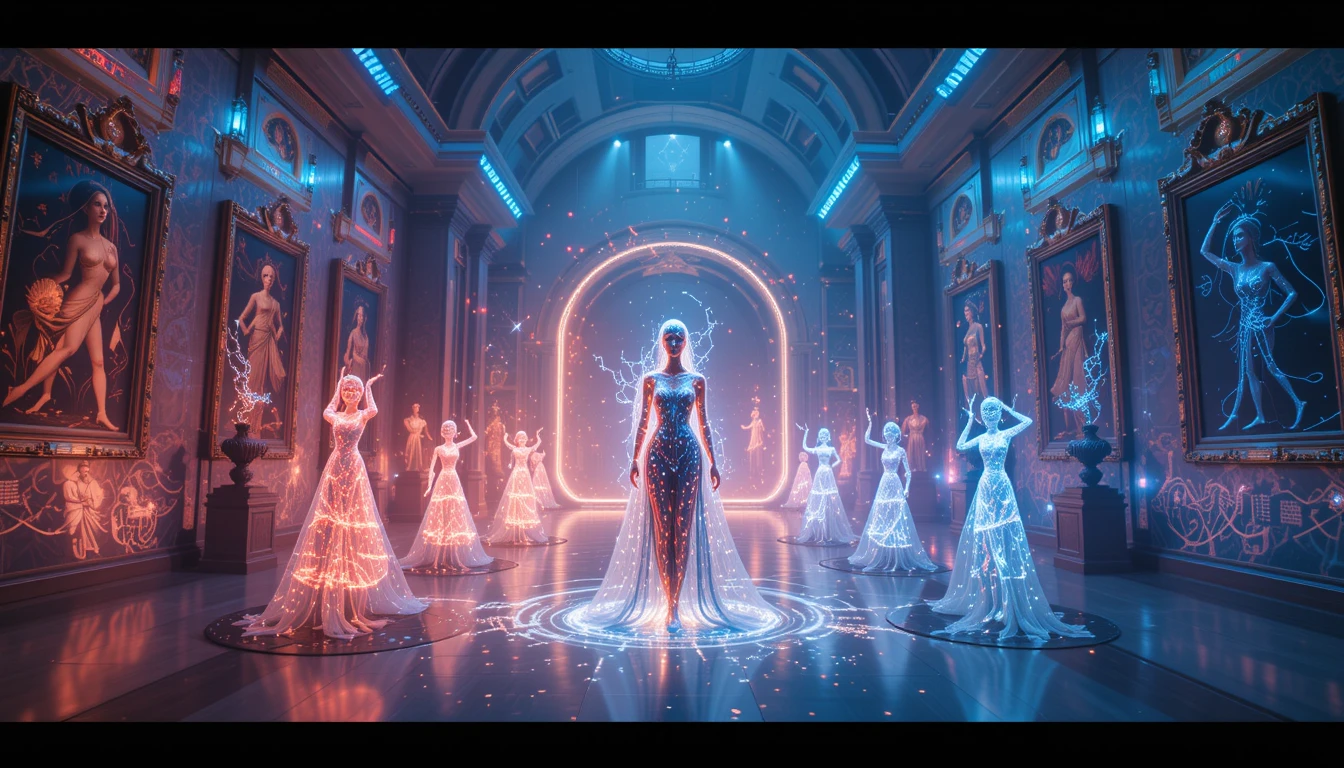
How AI Is Revolutionizing Human Creativity Through Art
Revolutionizing Creativity: AI Transforming Art
Discover how AI transforms art by acting as a creative collaborator, revolutionizing techniques, and shaping future artistic expression.
This article will explore the transformative impact of artificial intelligence on the creative landscape. It examines how computers are moving beyond simple computation to become essential partners in the art world. The discussion covers the evolution of AI-driven art production, its role in balancing control with creative accidents, and the potential future of AI as an artistic collaborator. Along the way, learn how traditional art forms intersect with modern technology, leading to innovative collaborations and inspired creativity.
🎨 ## 1. The Emergence of AI in the Creative Sphere
In a world where computers have become indispensable for business and education, the art industry is experiencing a creative revolution brought on by artificial intelligence. Imagine a technology that not only supports efficiency in administrative tasks but also breathes life into centuries-old aesthetics, bridging the gap between the timelessness of classical art and the fleeting nature of digital creation. This striking evolution – where algorithms learn from the masterpieces of the past to generate awe-inspiring new works – makes one ask: Can a machine truly capture the soul of art? The answer, as emerging trends suggest, is both nuanced and revolutionary.
Digital creativity is forging a path that goes beyond the traditional realms of computation. Historically, computers were utilized for their capacity to crunch numbers and generate predictable outputs in rigorous fields like finance and education. However, when it comes to the creative sphere, AI has stepped up as more than a mere tool for replication. As described in recent discussions on the subject, artists like Mario Klingerman are pioneering this integration by training neural networks on thousands of historical portraits dating from the 17th to the 19th centuries. These neural networks, which mimic the structure of the human brain, absorb the nuances, textures, and intricacies of classical aesthetics and then produce unique pieces that stir memories of painted masterpieces.
This creative transformation can be likened to the arrival of photography in the art world. Just as the camera once revolutionized artistic expression by capturing moments in unprecedented ways, AI is now enabling artists to explore creative landscapes that were previously unimaginable. The digital portraits conjured by artificial intelligence may evoke memories of oil paintings hung in old galleries, yet they are born from a complex interplay of precise algorithms and serendipitous accidents that disrupt the normative processes of traditional art-making. The beauty of this approach is not in the replacement of human creativity but in the amplification of it – offering artists a new palette of possibilities.
The evolving dynamics in the art sector reflect innovative research and technological breakthroughs that underscore the potential of AI as a creative collaborator. For instance, a deep dive into this technology reveals that when computers process thousands of historical portraits, the result is not a mere collage or repetitive motifs but a continuous stream of novel, unrepeatable artworks. This process is analogous to a painter who studies the great masters not to copy their work exactly but to internalize techniques that lead to new, original expressions. For more insights into the parallels between machine learning and art, one may explore MIT Technology Review and Forbes.
Moreover, AI’s infusion into the creative process is not confined to visual arts alone. There is a growing momentum of computer-generated music, literature, and even culinary arts that thrives on similar principles of learning from historical data and reinterpreting it in innovative formats. A prominent example is the capacity of AI to mimic and transform stylistic nuances that once belonged solely to human expression. Notably, research from Nature and Scientific American underscores that integrating historical art inputs into neural network training not only revives classical aesthetics but also expands the horizons of what is possible in contemporary creativity.
Historically, art has always been a conversation between the artist and their era. Today, this dialogue is enriched by the dialogue between human creativity and machine intelligence. The computer’s ability to analyze and reinterpret centuries-old works introduces a multifaceted view of art that is both reflective and forward-looking. Much like an artisan reworking a centuries-old technique into contemporary craft, AI synthesizes varied artistic elements into a form that resonates across time. It is this compelling blend of tradition and innovation that situates AI not merely as a new medium for expression, but as a bridge connecting the creative endeavors of the past with those of the future. For additional perspectives on art history and modern influences, consult resources like The Metropolitan Museum of Art and Tate Modern.
The seamless integration of AI into art exhibits a blend of technical precision and raw creative impulse that challenges the stereotypical boundaries of machine functionality. Where traditional artists might be encumbered by the repetitive nature of their craft, AI introduces a spontaneous element that rejuvenates creative output. This phenomenon can be understood as part of a broader trend in which AI acts as both observer and participant, absorbing centuries of aesthetic wisdom to inform the creation of artworks that are both reminiscent of historical epochs and boldly innovative. As highlighted by analysts in Harvard Business Review, the infusion of modern technology into creative processes is already reshaping how creative labor is valued in today’s economy.
Ultimately, the emergence of AI in the creative sphere is not a tale of replacement but of transformation. It calls to mind the idea that creativity, at its core, is a boundless process that evolves with its tools. As computers become ever more capable of mimicking and innovating upon traditional aesthetics, they empower artists to explore uncharted terrains of artistic expression. Thus, AI is not simply a digital brush or a mechanical replica; it is a new collaborator that expands the creative universe, inviting both artists and audiences to experience art in a radically reimagined form. For more detailed analysis on the evolution of creativity in the age of AI, explore Wired and BBC News Technology.
🚀 ## 2. AI as a Collaborative Tool for Artists
The narrative surrounding artificial intelligence in the creative world is not one of rivalry, but of collaboration. Rather than dethroning the artist, AI serves as a robust partner that bridges spontaneous creative accidents with the calculated precision of digital processing. At the heart of this innovation lies the fundamental redefinition of creativity. Once considered uniquely human, creativity is now seen as a shared endeavor where machine intelligence augments human intuition and vision.
Traditionally, creative work has involved a delicate interplay between control and happenstance. An artist meticulously plans each brushstroke while simultaneously remaining open to unforeseen accidents that add depth and character to the work. This balance is the essence of creativity, and AI is uniquely positioned to enhance that equilibrium. According to industry thought leaders, the use of AI in art is akin to welcoming a new kind of muse – one that is both precise and delightfully unpredictable. For example, when an artist engages with an AI system trained on thousands of historical portraits, they are not surrendering their craftsmanship to a machine; instead, they are inviting it to share in the creative process, infusing the end result with unexpected innovations and an enhanced depth of expression.
In this collaborative dream, the role of the artist expands beyond mere creation. It evolves to encompass roles that were not traditionally imagined in the realm of art. One such emerging role is the “data curator.” Much like a seasoned historian sorts through artifacts, a data curator selects and manages the vast digital troves that serve as the foundation for AI learning. This new role is not just technical – it demands an intrinsic understanding of aesthetics, historical context, and the potential of the digital medium. Insights from academic research and industry reports from institutions like University of Oxford and University of Cambridge underscore the strategic importance of integrating data curation into the creative process.
The paradigm-shifting nature of AI collaboration is illuminated through real-world creative experiments. Consider the analogies drawn between this technological revolution and the arrival of the camera. The camera, once a novel device, disrupted the art world by democratizing the process of capturing reality. Similarly, AI is challenging artists to think beyond traditional forms. It offers a new toolkit where precise control over the creative process is balanced by opportunities for random, yet fascinating, creative accidents. Every stroke of digital code applied by AI furthers the narrative of art in this emerging era. For further background on the transformation of traditional art with new technologies, look into articles featured on Artsy and The Guardian – Art & Design.
This integration of human and machine-driven creativity is more than a technological shift – it is a cultural evolution. In creative collaborations, AI offers a way to break free from the confines of repetitiveness that sometimes plague creative production. As explained by thought leaders in the tech-art space, AI’s capacity to “kick artists out of that mechanistic way of thinking” is a call to return to what it means to be inherently creative. By enabling a synthesis of control and serendipity, AI helps artists rediscover the raw essence of their craft, turning what might be seen as a deterministic process into a wellspring of innovative expression.
There is also a practical advantage to these AI-art collaborations. As AI continues to evolve and prove its reliability, the fear of the machine as a competitor is gradually giving way to the understanding that AI can function as an advanced extension of the creative mind. This evolution is reflective of broader transformations across industries, a phenomenon documented in detailed reports available through McKinsey & Company and Harvard Business Review. Such studies highlight how collaboration with AI not only enhances productivity but can also lead to an entirely new mode of creative labor – one that is adaptive, resourceful, and dynamically innovative.
Artistic experimentation with AI is replete with challenges and opportunities alike. The learning curve involves not just understanding a new tool but also redefining the parameters of what constitutes creative input. As AI systems advance in processing vast compilations of historical art styles, the resulting fusion of classical influence with cutting-edge innovation becomes a beacon of what is possible when technology is harnessed for creativity. This is evidenced by numerous projects where AI-generated portraits and compositions have captivated audiences worldwide. The media’s coverage of these endeavors, as seen in pieces on BBC News Technology & Arts and CNN Style, reinforces the emerging belief that AI’s contribution to art is a collaborative celebration rather than a competitive encroachment.
Moreover, this dynamic has begun to redefine how artistic success is measured. No longer is art solely about the outcome – it is about the process, the dialogue between creator and technology. This evolution is sparking conversations among art critics and technologists alike. The notion that AI might mediate a new form of aesthetic expression has even led to the proposition that future art will be evaluated not only for its visual appeal but also for its underlying narrative of innovation and collaborative effort. For more detailed studies on the future of creative industries, see research articles published by Taylor & Francis and Springer.
The inherent value of AI as a creative collaborator lies in its potential to dismantle the stereotypical narrative of machine-driven uniformity. Instead, it offers a pathway toward creative pluralism where every artistic endeavor becomes a joint venture of human inspiration and algorithmic insight. With this paradigm in mind, the role of the artist is no longer to fight against the tide of mechanization but to harness its potential. As AI continues to mature, artists are expected to experiment, iterate, and redefine creative boundaries in ways that embrace the digital revolution while remaining anchored in human tradition. For further reading on the convergence of art and technology, consider exploring essays on Art in America and Frieze.
Ultimately, AI’s role as a creative partner breathes new life into the world of art. It paves the way for creations that not only respect historical traditions but also forge paths into untapped realms of expression. In transforming the traditional art practice, AI helps artists to break free from mechanistic patterns – a sentiment echoed by experts who believe that the collaboration between human creativity and artificial intelligence will spark a renaissance of truly human-centric art. By challenging conventional methods and embracing the unexpected, AI is pushing the boundaries of what it means to be creative in the modern age. The evidence of this transformation is clear and promises to redefine aesthetics in ways that are as innovative as they are inspiring.
🤖 ## 3. Future Perspectives: Disruption and Innovation in the Creative Industries
As AI continues to establish itself in the creative sphere, the conversation inevitably turns to the future – a future where technological disruption is as much an opportunity for enhanced creative expression as it is a source of apprehension. This duality presents a transformative moment for industries that have long held human ingenuity as their cornerstone. Critics once feared that rapid technological progress might result in job losses and lead to a monotonous, imitation-driven creative landscape. However, extensive research and real-world experiments suggest that the risks, particularly in the realm of creative pursuits, are relatively overblown. Instead, AI is emerging as a dynamic collaborator that redefines, rather than replaces, human artistry.
Recent academic studies and analyses, including insights from research conducted in regions such as England, have noted that the potential for AI to negatively impact job retention in creative fields is minimal. Instead, the industry is projected to transform as new roles, such as the “data curator,” enter the creative ecosystem. Much like a composer relies on both instrumental skill and digital production techniques, future art careers will likely be a blend of traditional expertise and novel data-driven methodologies. For a comprehensive understanding of these trends, refer to detailed reports available through OECD and International Labour Organization.
One of the fascinating frontiers in the creative industry is the intersection between AI and music. Imagine an AI that can study the vocal nuances of legendary jazz singers like Ella Fitzgerald, then generate original tracks that mirror her captivating style. While such compositions may never rival the soul of a live performance, they illustrate AI’s potential to serve as both an imitator and an innovator. This capacity to generate art reminiscent of iconic styles without simply replicating them signals a broader paradigm shift – one where the essence of creativity becomes a continuous dialogue between human tradition and technological experimentation. For additional insights into the evolution of music and technology, explore the in-depth features on Rolling Stone and NPR Music.
The long-term perspective envisions a landscape in which AI evolves into an independent creative entity, perhaps even one that exhibits a form of consciousness. While this notion remains speculative, it forcefully underscores the speed at which AI can process and interact with historical art to unlock unprecedented avenues for innovation. When AI becomes capable of introspection and organic creativity, the convergence of art, technology, and human emotion may reach heights that are currently unfathomable. Think of it as the next step in evolution, where what was once a tool becomes a partner with its own unique perspective. Exploring these ideas in further depth can be aided by thought-provoking discussions on platforms like Edge and New Statesman.
Furthermore, the capacity of AI to rapidly interact with and reinterpret past art allows it to push creative boundaries in ways that human memory and technique alone simply cannot. The speed and precision with which neural networks process vast arrays of historical data instill a sense of possibility that redefines what art can be. Here, the dialogue is not about human versus machine, but about synergistic relationships where the instantaneous analysis of digital intelligence fosters new forms of artistic expression. This collaboration encourages creators to step out of comfort zones, challenge conventional paradigms, and generate art that is both introspective and boundary-breaking. Readers interested in the intersection of art and rapid technological progress can explore detailed analyses on Fast Company and Inc..
In the wake of this transformative shift, societal perceptions of creativity are bound to evolve. Rather than viewing AI as a disruptive force that might render human work obsolete, it is increasingly seen as a catalyst that expands the creative horizon. Artists and industries are beginning to understand that collaboration with AI opens unprecedented opportunities to reimagine creative processes. Rather than an adversary, the machine becomes an indispensable creative partner – reshaping narratives, inspiring innovation, and proving that creativity is a realm where the human touch remains irreplaceable. This renewed perspective is gaining traction in both academic and industry circles, as observed in strategic commentary from research outlets like Strategy+Business and Bloomberg.
The forward-looking vision for AI in creative industries is unmistakable: enhance creative expression, stimulate new roles, and accelerate the pace of artistic innovation. While changes in the job landscape might cause initial uncertainty, the reality of these transitions is that creativity is not being mechanized or diminished; rather, it is being elevated by harnessing the best of both human and digital contributions. As emerging research continues to debunk the notion of AI-induced job losses in creative fields, myths are being replaced by concrete strategies for augmenting the creative workforce. This collaborative model is further supported by insights from technological incubators and creative hubs around the globe, including platforms reviewed on Creative Review.
Envision a future where the art world is not hindered by the limitations of tradition but propelled by the combined force of human ingenuity and AI precision. Within this landscape, every brushstroke, every note, and every digital impression carries the legacy of the past alongside the promise of future innovation. Artificial intelligence, in its role as a creative collaborator, is setting the stage for an evolution in art that is as profound as any cultural renaissance in history. It is an evolution that invites artists, audiences, and technologists alike to reframe their understanding of creativity and to embrace a future where the boundaries between human and machine creativity blur in the most inspiring ways. For further reading on transformative trends in technology and art, visitors can also refer to thought leadership pieces on Digital Arts Online.
This dynamic intersection of art and automation heralds a transformative era in creative expression. Through inventive collaborations that fuse historical artistry with modern computational power, AI is steadily transforming creative landscapes across diverse disciplines. What remains indisputable is that the creative future is bright, filled with possibilities born from the marriage of tradition and innovation. Far from reducing human creativity to a predictable routine, AI is providing the spark that inspires artists to explore new realms of expression, breaking free from repetitive patterns and re-imagining the art form from within. In this light, every creative endeavor becomes an odyssey where human imagination is supercharged by the relentless precision of digital intelligence.
The converging narratives of creative tradition and technological progress are rewriting the rules of the art world. As AI continues to mature and redefine creative processes, it will undoubtedly foster an environment rich in novel ideas and innovative approaches to art production. Each step forward is punctuated by moments of serendipity and milestones of breakthrough, echoing the sentiment that creativity is an ever-expanding dialogue between the human narrative and the digital pulse. For those who wish to explore the broader implications of AI in modern society, additional insights can be found in reports by Pew Research Center.
Ultimately, the future of the creative industries lies in embracing the dualities that AI introduces. There is no singular script for progress – it is a mosaic composed of human artistry, advanced algorithms, and the unpredictable magic that occurs when both realms intersect. In doing so, the creative industries do not just survive the age of automation; they thrive, innovate, and redefine the essence of art for generations to come. As the dialogue continues and the partnerships between humans and machines deepen, the revelation is clear: creativity is infinite, and its evolution is only just beginning.
This new era of AI-driven collaboration transcends the simple narratives of threat and replacement. Instead, it invites a holistic understanding of how technology can enrich the tapestry of human creative expression. By drawing on the past, leveraging advanced digital methods, and daring to paint outside the lines, the creative workforce is set to usher in a renaissance that is as vibrant as it is visionary. The art of tomorrow is not anchored in what was, but in the boundless possibilities unlocked by technology today – a journey where the meeting of human passion and machine precision continually paves the way for groundbreaking innovations and a reimagined cultural landscape.
Drawing inspiration from the symphony of tradition and technological evolution, this forward-looking vision emphasizes that the creative journey is a perpetual exploration of what lies beyond the horizon. In the spirit of progress, every disruptive innovation serves as a stepping stone toward a future where art and technology coalesce into a form of expression that is truly transformative. With AI as an enduring collaborator and catalyst, the creative industries are poised to harness the unbridled potential of human ingenuity – inviting us all to see, imagine, and create a future that is as daring as it is beautiful.
By intertwining history, technology, and creative aspiration, the story of AI in the creative industries is one of endless possibility and dynamic evolution. Its narrative is written in the interplay of control and unexpected accident, reflecting an art form that is continuously fulfilled by the collaboration between human spirit and digital brilliance. Whether through innovative portraits inspired by centuries of tradition or melodies that echo the legends of the past, the future promises a vibrant canvas on which creativity knows no bounds. For ongoing updates and detailed analyses of this unfolding revolution, readers are encouraged to explore further insights on platforms such as The New York Times Technology.
In this era of transformation, AI is not just a tool for generating art – it is a strategic partner that propels creative industries into a future defined by innovation, collaboration, and endless creative potential. From revolutionizing traditional artistic techniques to redefining the roles within creative teams, the incorporation of AI epitomizes the dynamic synergy between human creativity and machine efficiency. This dynamic evolution is a testament to the fact that digital intelligence, far from stifling artistic expression, is in fact expanding the realm of what is creatively imaginable. Each brushstroke, melody, and digital design born out of this collaboration is a vibrant testament to the endless possibilities that arise when conventional methods are reimagined in a new, technology-enhanced light.
As the digital canvas of art continues to expand, the partnership between human emotion and algorithmic precision promises not only to preserve the rich heritage of artistic traditions but also to usher in an era of innovation that redefines the very nature of creativity. With AI leading the way as a collaborative force, the art world is set to transcend boundaries, celebrate diversity in creativity, and inspire future generations. The journey is ongoing, the possibilities are endless, and the transformative power of AI in the creative sphere is only just beginning to reveal itself.
In conclusion, as the creative industries steadily embrace the revolution of digital intelligence, they are laying the foundation for a future where collaboration between human and machine is not only inevitable but also essential for the continued evolution of art. The dialogue between tradition and modernity, order and spontaneity, control and serendipity – all converge to create a dynamic art form that promises to reshape our cultural landscape. The promise of AI as a creative collaborator is not a distant vision but an unfolding reality, one that heralds a renaissance in the art world where the boundaries of creativity are continually redefined. Embracing this future means celebrating the fusion of historical inspiration with modern innovation – a journey that is as challenging as it is exhilarating.
With this evolving narrative taking center stage, the creative industries are embarking on a revolutionary path, celebrating the vibrant interplay between human imagination and artificial intelligence. The capacity of AI to learn from the annals of art history, to mimic and innovate simultaneously, and to enrich creative endeavors is setting the stage for an extraordinary future. This journey is a celebration of progress, an ode to creativity, and a compelling call to embrace a future where art is limited not by tradition or technology, but only by the boundaries of human vision.
Through the exploration of these transformative ideas and the continual interplay between art and AI, the creative industries are poised to define a new era of innovation, expression, and cultural change. The stage is set for a creative renaissance, fueled by a synergy that marries historical insight with cutting-edge technology. As this narrative unfolds, the partnership between human artists and AI will not only enhance aesthetic expression but also redefine the very essence of creativity for a future that is as limitless as it is inspiring.