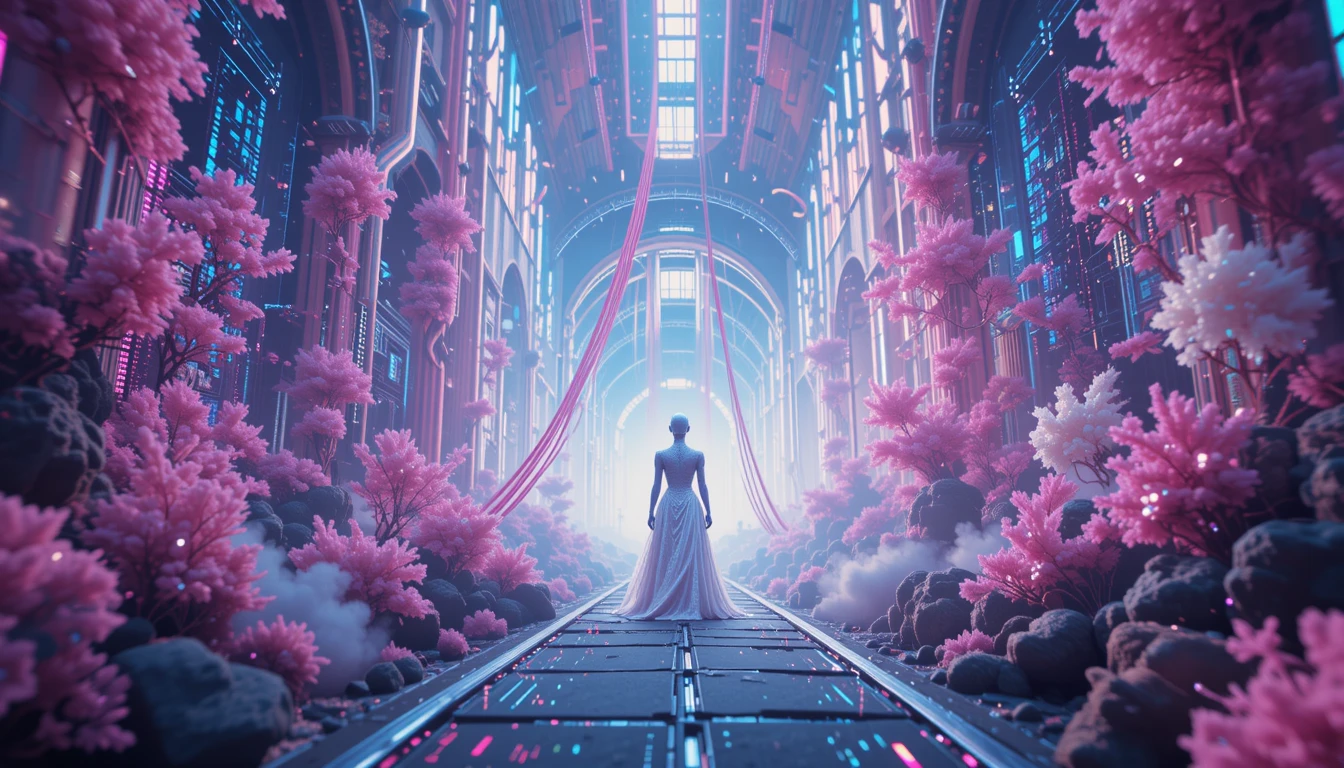
Can AI Be Truly Creative or Just Mimic Human Imagination?
Is AI’s Creative Spark Genuine or Just Mimicry?
Exploring AI creativity from historical breakthroughs to today’s innovative art, music, and storytelling tools versus human ingenuity.
This article delves into the evolving world of AI creativity, examining whether machines truly generate innovative art or simply simulate human expression. The discussion spans historical milestones, breakthrough AI tools, and the ongoing debate between machine-generated innovation and human intuition.
🧠 The Evolution of AI and Creativity
Can Machines Truly Be Creative? An Enduring Question
At the intersection of technology and imagination lies one enduring question that continues to fascinate and challenge: can machines truly be creative? Historically, creativity has been framed as a unique hallmark of our humanity—an intricate mosaic woven from emotions, intuition, lived experiences, and cultural insights. It’s regarded as a spontaneous manifestation of inner worlds—a deeply personal and sometimes ineffable human trait. However, as we push deeper into the era of artificial intelligence, machines begin to surprise us, compelling humanity to reconsider these assumptions. AI-generated artwork, compositions, and storytelling outputs have expanded the realms of what’s creatively possible.
Yet skepticism remains pervasive. Many argue AI’s outputs, although intriguing or visually impressive, lack genuine emotional resonance and existential depth. Is AI merely imitating human ingenuity, or are we on the cusp of redefining creativity itself? The deeper we delve into this intersection, the more complex and nuanced the relationship between artificial intelligence and human imagination becomes.
Turing, AARON, and Early AI Art Explorations
The intertwining journey of AI and creativity began during the mid-20th century, a pivotal era marking humanity’s ambitious step into the computer age. In 1951, visionary mathematician Alan Turing proposed what became famously known as the Turing Test—a groundbreaking thought experiment aimed at understanding whether machines could replicate human-like intelligence convincingly enough to be indistinguishable from actual human behavior. Although initially not explicitly tied to creativity, the Turing Test inspired influential discussions about machines possessing human-like cognitive capacities, including creative thinking and imaginative problem-solving.
In subsequent decades, creativity-specific experiments quickly emerged. Perhaps one of the pioneering landmarks was Harold Cohen’s renowned AI art generator known as AARON. Created in the late 1960s, AARON was a revolutionary computer program capable of generating original, abstract, and vividly geometric artworks independently. While today’s algorithms have advanced considerably, AARON challenged the centuries-old notion that art was an intrinsic human activity. Suddenly, creativity was not just confined to our species—it became a programmable possibility.
Additionally, AI experiments rapidly expanded in music as early computational models appeared. For instance, software like EMI (Experiments in Musical Intelligence) by David Cope was able to craft compositions emulating classical maestros such as Bach, raising complex philosophical questions: Is musical creativity merely algorithmic, or does it require something more profound and emotionally driven?
These nascent yet courageous explorations seeded what we now refer to as computational creativity, where machine intelligence intertwines seamlessly with artistic expression, forever reframing creativity discussions.
🚀 Modern Tools Revolutionizing Creative Fields
Visual Arts: From Prompts to Masterpieces
We’re now witnessing unprecedented advancements in AI-powered visual arts. Algorithms such as DALL-E, Midjourney, and Stable Diffusion profoundly impact creative paradigms. These sophisticated AI systems let artists and creators input descriptive text prompts, leading the AI to create detailed, vivid visual images. An imagined scenario—a Shiba Inu riding a skateboard, an astronaut lounging in tropical waters—materializes into detailed visual outputs that effortlessly blur reality and fantasy. These tools unlock limitless creative potential, empowering visionaries to materialize previously impossible dreams.
Music Composition Enhanced by AI Platforms
Music composition technology has similarly flourished, with platforms like Amper Music, AIVA, and OpenAI’s Jukebox redefining sonic creativity. Musicians and composers now harness algorithms that autonomously create intricate melodies, harmonies, beats, and even intricate orchestral arrangements. Artists collaborate with these deeply intuitive programs, often challenging the borders of traditional compositional norms, genres, and listener expectations—thereby enriching musical landscapes with newfound creative possibilities.
AI-Assisted Writing: The True Co-Author
Writing has undergone similar AI-induced transformations. With groundbreaking language processing models like GPT-3 (and its successors), as well as specialized tools like Jasper or Copy.ai, AI technology has significantly bolstered writing processes. These tools help creators by suggesting ideas, generating narratives, translating languages seamlessly, and refining stylistic elements—effectively becoming invaluable, creative co-authors. While high-quality storytelling maintains human layers of emotional depth, AI supplements creativity by immediately offering vast explorations of potential avenues and creative choices, driving inspiration and productivity to unparalleled heights.
Empowering the Modern Creator
Crucially, AI isn’t just performing tasks traditionally regarded as exclusively human—it often amplifies and broadens the creative process itself. Machine learning algorithms decipher vast datasets of historical art styles, musical trends, and narrative structures to produce unexpected and inspiring results. Rather than replacing human creators, AI introduces previously unattainable possibilities and sparks powerful new forms of artistic collaboration—co-creating unprecedented expressions far exceeding historical creative boundaries.
🎨 Human Creativity vs AI: A Comparative Analysis
While current AI outputs astonish and amaze, essential distinctions remain between algorithmic and human creativity.
Rooted in Emotional Insight: The Human Advantage
Human creativity fundamentally stems from an intricate web of lived experiences, intuition, culture, and empathy. This foundation allows artists, composers, and writers to create profound emotional connections with audiences, depicting complex narrative depths, abstract symbolism, and shared understandings of humanity. This subjective, experiential element remains challenging for algorithms to replicate, as machines inherently lack genuine feelings or consciousness—a shortcoming many researchers argue creates emotional hollowness in purely algorithmic creations.
AI’s Algorithmic Strength: Pattern Recognition on Steroids
In contrast, and yet intriguingly complementary, lies AI’s extraordinary strength in recognizing patterns and generating variations systematically. This capability enables it to swiftly craft extensive, intricate creative permutations beyond typical human scope. AI’s forte thereby lies in methodical iteration and recombination, often yielding technically vibrant, conceptually innovative results.
Authentic Creativity or Sophisticated Mimicry?
However, it’s precisely here that debates intensify. Is AI’s creative output genuinely original or merely brilliant mimicry? Despite notable sophistication, critics argue that AI-generated creativity intrinsically lacks human-style authenticity and depth—qualities often derived from subjective experiences.
🌌 Notable AI Art Experiments and Emerging Trends
Edmond de Belamy and Generative Adversarial Networks (GANs)
Perhaps no instance illustrates AI creativity’s impact clearer than “Portrait of Edmond de Belamy.” Created using a Generative Adversarial Network (GAN) by French art collective Obvious, this AI-generated artwork was famously auctioned at Christie’s, making history by fetching over $430,000. This landmark event undeniably positioned AI creativity within classical art markets, forever reshaping artistic valuation perceptions.
Google Magenta Pushing Boundaries of Artistic Expression
Google’s Magenta project further exemplifies vibrant versatility in computational creativity research. Through Magenta, Google explores, composes, and experiments across music, poetry, and interactive art installations, underscoring AI’s collaborative potential to enhance and amplify traditional creative endeavors.
Interactive Storytelling with AI Dungeon
Interactive narrative tools like AI Dungeon offer dynamic story-building platforms co-created by AI and users alike, mixing spontaneous storytelling flexibility with advanced AI’s narrative versatility. AI Dungeon highlights AI’s capacity to blur storytelling boundaries, enabling deeply engaging, personalized scenarios otherwise impossible through traditional methods.
In this continual evolution, AI and human creators collaboratively sculpt unprecedented artistic frontiers, signaling a future marked by innovation, creativity, and boundless possibility.