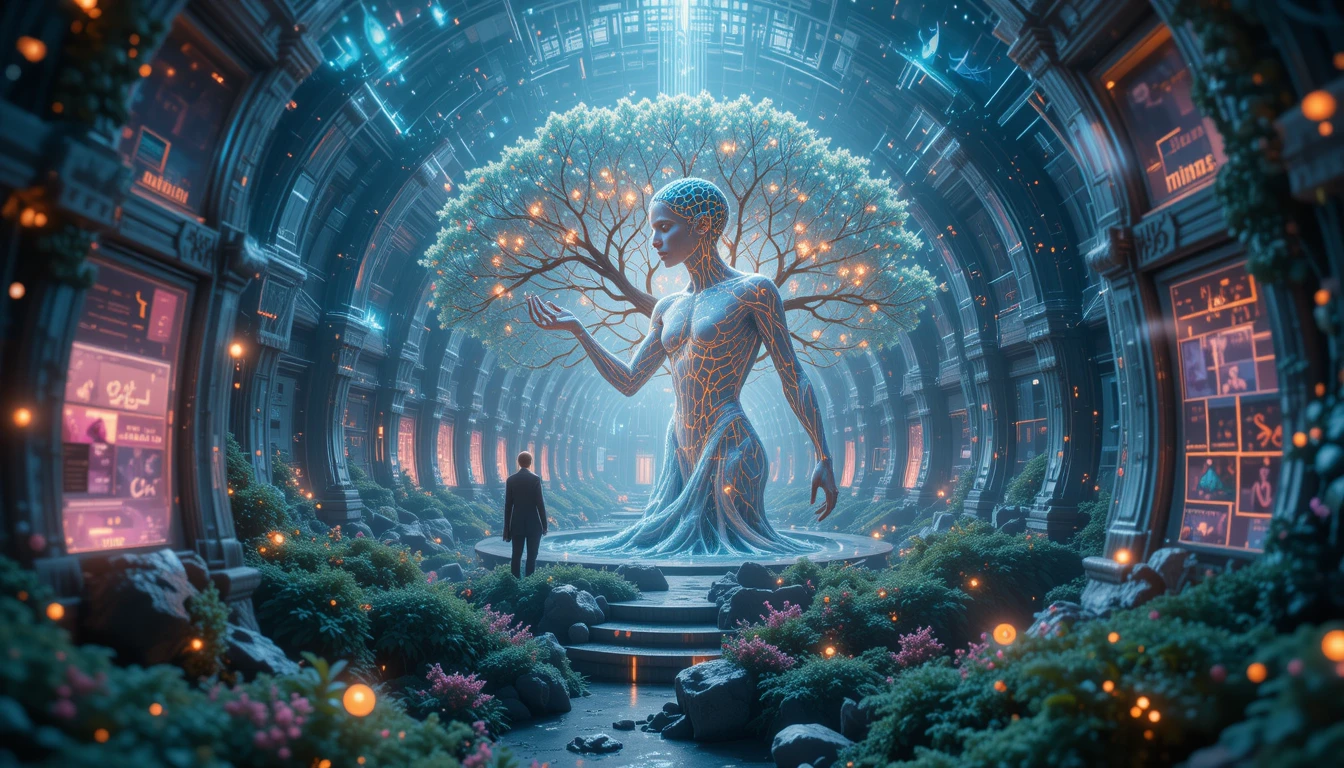
Unlocking AI’s Power: How Machines Learn, Think and Create
Unleashing AI’s Potential: Machines That Learn, Think and Create
Discover how artificial intelligence empowers machines to learn, reason, and create. Explore machine learning, deep learning, and generative AI in this insightful guide.
This article explores the evolution and breakthroughs in artificial intelligence, where computers transition from following fixed instructions to exhibiting dynamic learning and creativity. The guide delves into key concepts such as machine learning, deep learning, and generative AI while uncovering how these technologies are revolutionizing industries. With clear explanations and engaging examples, readers will gain a comprehensive understanding of what makes AI a powerful force in modern technology.
🎯 ## 1. Understanding the Foundations of Artificial Intelligence
Artificial Intelligence (AI) is not merely a buzzword; it represents a paradigm shift in how technology interacts with the world. Imagine computers that are bestowed with a form of “brain” – a capacity to learn, adapt, and decide. Traditionally, computing was all about following pre-defined instructions, like a recipe that never changes its ingredients no matter how the environment shifts. However, with AI, the rulebook itself transforms over time as machines unearth hidden patterns in vast amounts of data. As described during the Cloudmaster Live session, AI is essentially about granting computers the ability not just to compute but to think in a sense that mirrors human problem-solving.
Conceptually, AI dissolves the boundary between rigid, algorithmic computing and more dynamic forms of decision-making. Computers endowed with AI can process information in a way that evolves, leading them to uncover subtle patterns that might elude human analysts. This is analogous to exploring a labyrinth of data where each twist and turn might reveal a previously unseen connection among seemingly unrelated pieces of information. For example, consider the extensive research published by IBM on AI or insights shared on Forbes Tech Council—they both emphasize that AI is about dynamic learning. Here, the significance is not limited to large-scale, industrial design; even everyday applications, such as recommendation systems or smart home devices, demonstrate AI’s capacity to enhance routines through adaptive learning.
To delve deeper, AI can be seen as an evolutionary leap from traditional computing approaches. Whereas older systems performed tasks based solely on explicit instructions, AI systems interpret input to generate evolving outcomes that reflect an understanding of context and nuance. The implications for industries are far-reaching: from transforming healthcare diagnostics to revolutionizing customer service, AI-driven innovations serve as catalysts for both efficiency and creativity. Notably, MIT and Stanford University continue to push boundaries in their research on adaptive algorithms, showcasing how AI is increasingly becoming embedded in the fabric of modern technology.
Furthermore, the integration of AI into everyday technology means that the decisions made by these “thinking machines” have tangible effects on society. Enhanced pattern recognition allows for improved financial fraud detection, refined image and speech recognition, and innovative approaches to personalized medicine. One striking real-world example is the application of AI in climate research, where data from thousands of sensors across the globe is processed to predict environmental changes with unprecedented accuracy. Moreover, the convergence of AI and other emerging technologies such as the Internet of Things (IoT) is reshaping infrastructure, fortifying everything from urban planning to automated transportation systems. Detailed explorations on these synergistic effects can be found in articles by Wired and Nature.
In essence, AI’s core foundation is the transformation of passive computing into active and evolving intelligence. By transitioning from a model of static, rule-bound processes to a dynamic, learning-based model, AI represents not only a technological revolution but also a profound shift in how challenges are approached and solved across all sectors of society.
🚀 ## 2. Exploring Machine Learning – Teaching Computers to Learn
Machine learning (ML), a critical subset of AI, focuses on the empirical process of teaching computers to learn from data without the need for explicit instructions at every step. The philosophy behind machine learning is strikingly simple yet immensely profound. Rather than pre-programming every possible outcome, ML harnesses statistical methods to enable computers to derive their own rules based on patterns observed in diverse datasets. This process mirrors how humans learn from experiences, constantly adjusting their understanding of the environment based on new inputs.
At its core, machine learning involves feeding computers with huge volumes of data collected from various sources – images, text, and sounds. For instance, consider training a computer to recognize cats: a task that starts with showing the machine thousands of images of cats, each image featuring the distinct feline attributes such as fur, whiskers, and eyes. With every additional image, the machine refines its understanding incrementally, much like a child learning to distinguish between similar objects by observing subtle differences. As detailed during the Cloudmaster Live session, this iterative process is what transforms a basic computer into a predictive powerhouse. Readers seeking a deeper dive into the mechanisms of machine learning may refer to research by Google AI or articles published on MIT Technology Review.
Breaking the process down further, ML typically involves several stages:
- Data Collection: Gathering images, text, or sound clips from diversified sources.
- Data Preprocessing: Cleansing and organizing the data to ensure that it is in a usable format.
- Model Training: Feeding the preprocessed data into algorithms so they can identify and learn from the inherent patterns.
- Prediction and Feedback: Applying what has been learned to make real-life predictions and iterating based on the accuracy of those predictions.
This step-by-step learning journey is what enables machines to offer progressively refined decision-making. In real-world applications, machine learning is the engine behind technologies ranging from voice recognition assistants to sophisticated fraud detection systems. These systems have become indispensable in industries like finance, healthcare, and e-commerce, where the ability to adapt to shifting data streams translates directly to enhanced performance and security. With every additional dataset, ML models improve their accuracy, effectively becoming smarter and more reliable over time, as exemplified by case studies discussed on IEEE Spectrum and showcased in analyses on ScienceDirect.
Moreover, machine learning’s influence extends to shaping the future of personal digital experiences. Consider personalized recommendations on streaming services or the continually evolving capabilities of digital personal assistants—these are all powered by ML models that analyze behavior and adapt to user preferences in real time. This transformative capacity underlines the importance of machine learning as both a technological instrument and a fundamental shift in how computers process and react to data. Enriching this dynamic interplay of data and decision-making, machine learning emerges as the bridge between traditional computational methods and the self-improving systems of tomorrow.
🧠 ## 3. Delving into Deep Learning and Neural Networks
Deep learning is a specialized branch within machine learning that harnesses the power of artificial neural networks to process data in innovative ways. These networks mimic the human brain’s structure, consisting of millions – and sometimes billions – of interconnected neurons that work together to understand and interpret complex patterns. Deep learning builds upon the foundational concepts of machine learning but takes the ability to “learn” to extraordinary new levels by incorporating layered networks.
The architecture of deep learning is both fascinating and intricate. Imagine a vast network where every neuron acts as a tiny decision-maker, much like a cell in a living organism. This concept was eloquently summarized at Cloudmaster Live, where artificial neural networks were compared to the billions of neurons in the human brain. Each layer of the network processes information, from basic visual features like edges and colors in early layers, to highly abstract concepts captured in deeper layers. This progression is crucial in tasks like image recognition, where a digital model can transition from merely noticing shapes to recognizing entire objects. More detailed discussions about these processes can be found in educational resources from DeepMind and technical insights on NVIDIA Deep Learning.
To understand deep learning more thoroughly, consider its use in natural language processing (NLP). In NLP applications, neural networks are tasked with deciphering semantic meanings, contextual cues, and subtleties in human language. This involves multiple layers that gradually build an intricate understanding of language constructs. A popular real-world application is the development of language models capable of generating remarkably human-like text. Such models analyze everything from grammatical structures to narrative patterns, and their effectiveness has spurred innovation across multiple industries, from journalism to automated customer service platforms. For further reading on these advancements, reputable sources such as Scientific American and Nature Deep Learning provide comprehensive insights into the latest research and breakthroughs.
The transition from machine learning to deep learning represents a significant leap — it is the movement from simple pattern recognition to sophisticated, multi-layered understanding. In image processing, for example, deep learning networks are the driving force behind modern facial recognition technologies, autonomous vehicles, and even medical diagnostics where early disease detection is critical. These networks are capable of recognizing subtle nuances, such as distinguishing healthy tissue from abnormalities in medical imagery, a task that requires the integration of layered learning and refined signal processing. Journals like Trends in Biotechnology offer detailed case studies on how deep learning is revolutionizing healthcare diagnostics.
Additionally, the inherent complexity of neural networks necessitates robust computational power, which in turn has driven major advancements in hardware design and cloud computing. Platforms such as Amazon Web Services (AWS) for Machine Learning and Microsoft Azure AI have become essential tools in training and deploying deep learning models. These platforms allow researchers and businesses alike to harness massive computational resources, making it feasible to train networks that comprise millions of parameters in an efficient and cost-effective way. In essence, deep learning and neural networks are not just about creating smart systems—they are about fundamentally transforming the way data is understood, processed, and applied, opening up new avenues in technology and innovation.
🎨 ## 4. Generative AI – Enabling Creative Intelligence in Machines
Generative AI is emerging as a groundbreaking field within deep learning that goes beyond analysis to create entirely new content. Rather than simply processing information to make decisions, generative AI empowers machines to act as creative partners, capable of producing new art, music, text, and innovative designs from scratch. This represents not only a technical evolution but also a profound expansion in the realm of creativity. At Cloudmaster Live, this domain was introduced as the next frontier in machine creativity – one where machines no longer remain confined to analyzing existing data, but actively contribute to the creative process.
The mechanism behind generative AI is rooted in learning from large datasets but then using that learned knowledge to produce content that did not exist previously. Imagine a digital artist who, after studying thousands of paintings, can then combine different artistic styles to create something entirely new and distinctive. This process is achieved through models that understand artistic elements—such as color, composition, and brush stroke—allowing the AI to blend these features creatively. For tech enthusiasts who want to explore these concepts further, overviews on platforms like OpenAI and DeepAI offer fascinating insights into how generative adversarial networks (GANs) and other models operate behind the scenes.
Language generation represents another hallmark of generative AI. Leveraging vast textual datasets, language models have achieved an astonishing level of fluency in generating text that resembles human writing. These models can produce compelling narratives, creative stories, technical articles, and even poetry. The ability of such models to mirror the idiosyncrasies of natural language—its rhythm, vocabulary, and contextual cues—provides a powerful tool for content generation and translation. Detailed studies, such as those found on ScienceDirect’s NLP resources and insights via MIT Technology Review’s AI section, highlight how these models are pushing boundaries in communication and creative writing.
Generative AI also implies an exciting confluence of art and technology. Recently, AI-generated paintings have taken center stage on international art platforms, where algorithms trained on vast datasets of classical and modern art styles produce innovative visuals that blend tradition and modernity. This not only challenges conventional perceptions of creativity but also sparks collaborations between human creators and machines. For instance, a piece generated by an AI system might incorporate elements from Renaissance art while introducing futuristic design cues—a blend that is both surprising and intellectually stimulating. Further perspectives on the interplay of art, technology, and AI-driven creativity can be found in features on ArtNews and The Verge.
This confluence of creativity and computation is not without its challenges. One notable area of discussion involves the ethical and legal dimensions of generative AI—questions of originality, intellectual property, and the potential for biases in generated content are topics of both academic debate and commercial interest. As generative AI continues to evolve, establishing clear guidelines and ethical frameworks is essential. These ongoing debates are well-documented in reputable publications such as Brookings Institution and IEEE Spectrum, which detail the broader implications of technology intertwined with human creativity.
In summary, generative AI heralds an era where creativity is not the sole domain of the human mind. It transforms the way art and ideas are conceived, offering exciting opportunities for innovation in fields as diverse as literature, music, visual arts, and even scientific research. In the same way that the invention of the printing press democratized knowledge, generative AI has the potential to democratize creativity. Such innovative shifts are being closely monitored by institutions and research centers that champion the integration of human insight with machine efficiency.
🌟 ## 5. The Future of AI – Boundless Possibilities and Industry Transformation
Looking ahead, the horizon of AI appears limitless. With generative AI paving the way for creative partnerships between man and machine, the future promises a deep integration of AI-driven innovations across multiple industries. The potential applications of AI extend far beyond automation—they are transforming industries, reshaping business strategies, and redefining what it means to be productive in an increasingly digital world. During the Cloudmaster Live discussion, it was emphasized that the future of AI is not a far-off dream but an imminent reality that will fundamentally alter sectors such as healthcare, engineering, art, and finance. For in-depth perspectives on these disruptive trends, sources like Harvard Business Review and McKinsey & Company provide cutting-edge analyses and forward-thinking strategies.
Industries are now poised to harness AI for real transformative power. In healthcare, AI algorithms are enhancing diagnostic accuracy, predicting disease outbreaks, and personalizing treatment plans, all of which have been validated in studies from clinical research journals and platforms like National Institutes of Health. Engineering firms utilize AI to simulate and optimize complex designs, ensuring that structures are not only efficient but also sustainable. Meanwhile, creative industries such as film, music, and literature are witnessing an infusion of AI, with generative models offering new avenues to overcome creative blocks and inspire innovative storytelling. Alongside these examples, educational institutions and research bodies, including UC Berkeley and University of Cambridge, are actively exploring AI as a tool for both societal improvement and individual empowerment.
The path forward is intricately tied to continuous innovation. Future trends point toward even more seamless integration of AI into daily operations, where creative machines will work hand-in-hand with human experts to solve multifaceted problems. This may mean the advent of AI-guided design in architecture, where algorithms assist in developing more resilient infrastructure. It may also translate into revolutionary advancements in renewable energy or breakthroughs in personalized medicine through the targeted identification of anomalies in vast datasets. As these trends converge, platforms dedicated to advancing AI research and collaboration, such as the Google AI Research hub and initiatives by OpenAI, are playing critical roles in shaping a future that leverages machine ingenuity for human prosperity.
Yet, this bright horizon does come with its set of challenges. As AI’s capabilities expand, so too does the need for thoughtful regulation, ethical frameworks, and continuous dialogue about the role of machines in society. Questions about data privacy, accountability, and ethical decision-making will undoubtedly shape the landscape. Agencies like the Federal Communications Commission and policy research organizations, such as RAND Corporation, are already engaged in discussions on how to curate this new digital frontier responsibly.
Moreover, the boundless potential of AI is matched by its capacity to disrupt traditional job markets and business models. While some fear the displacement of human workers, others see an unprecedented opportunity for upskilling and the creation of roles that are as yet unimagined. In this technological transition, the vision is not to let machines replace humans, but to enable a symbiotic evolution where both work in concert for enhanced productivity and innovation. Thought leadership articles in The Wall Street Journal and analyses from Bloomberg Technology capture this dual-edged impact, offering fresh insights into how industries can navigate this radical transformation.
Looking at the broader picture, the future of AI is an intersection where technical prowess meets visionary aspirations. Envision a scenario where an AI system not only designs a sustainable urban framework but also contributes to formulating policies that address climate change. Or consider healthcare innovations where AI bridges the gap between early diagnosis and effective treatment through real-time analytics. Such future possibilities underscore the transformative role that platforms like Rokito.Ai play in driving these advancements, acting as catalysts for collaborative innovation and technological progress.
Indeed, the narrative for AI is one of boundless exploration. Generative capabilities are merging with robust predictive systems, creating technology that is as adaptive as it is inventive. As this journey unfolds, the collective aspiration is to build systems that are not only efficient and productive but that also uplift societies, democratize innovation, and empower future generations. For those eager to stay abreast of evolving trends, periodic updates and research summaries from sources like ScienceDaily and Nature Artificial Intelligence offer valuable insights into the revolutionary steps being taken every day.
To encapsulate, the future of AI is a vibrant tapestry of innovation, ethical challenges, and immense opportunity. It represents a future where artificial and human intelligences are intertwined to address challenges from environmental sustainability to social equity. As industries transform and new paradigms emerge, generative AI and its allied fields will stand at the forefront of technological progress. This transformation is fueled by robust academic research, pioneering industry efforts, and the unwavering pursuit of excellence in innovation—a synergy documented extensively by Scientific American and reinforced by ongoing discussions within forums like TED Talks on AI.
Collectively, these developments not only illustrate the spectacular potential of AI but also underscore the economic and societal shifts that accompany technological revolutions. In this brave new digital landscape, AI is not just a tool but a transformative force that challenges the status quo and heralds an era where creativity, intelligence, and innovation converge in unprecedented ways.
As the digital revolution accelerates at an ever-increasing pace, it is clear that AI will continue to shape every facet of life – from the micro-level of personalized user interactions to the macro-level of global industrial innovations. The expansive journey of AI is still unfolding, and with each passing breakthrough, humanity moves closer to a future that is not only smarter but also more inclusive and resilient.
In summary, the exploration of AI—from its foundational principles through the layers of machine learning, deep learning, and generative AI to its future possibilities—reveals a landscape rich with opportunities for transformation and innovation. The relentless march of technology, combined with an increasing understanding of ethical and strategic imperatives, will continue to pave the way for a future where human ingenuity and machine intelligence coalesce to solve the most pressing challenges of our time.
By embracing this synergy, industries and societies can look forward to a new era defined by boundless creativity, efficient systems, and an overall uplift in quality of life. The interplay between data, algorithms, and human insight is not merely a technical narrative but a profound story of progress that will shape the fabric of civilization for decades to come.
With platforms dedicated to transforming how people and machines interact, the promise of AI is no longer a distant dream – it is here, evolving and expanding at the speed of thought, igniting the potential for a future that is as innovative as it is inclusive.