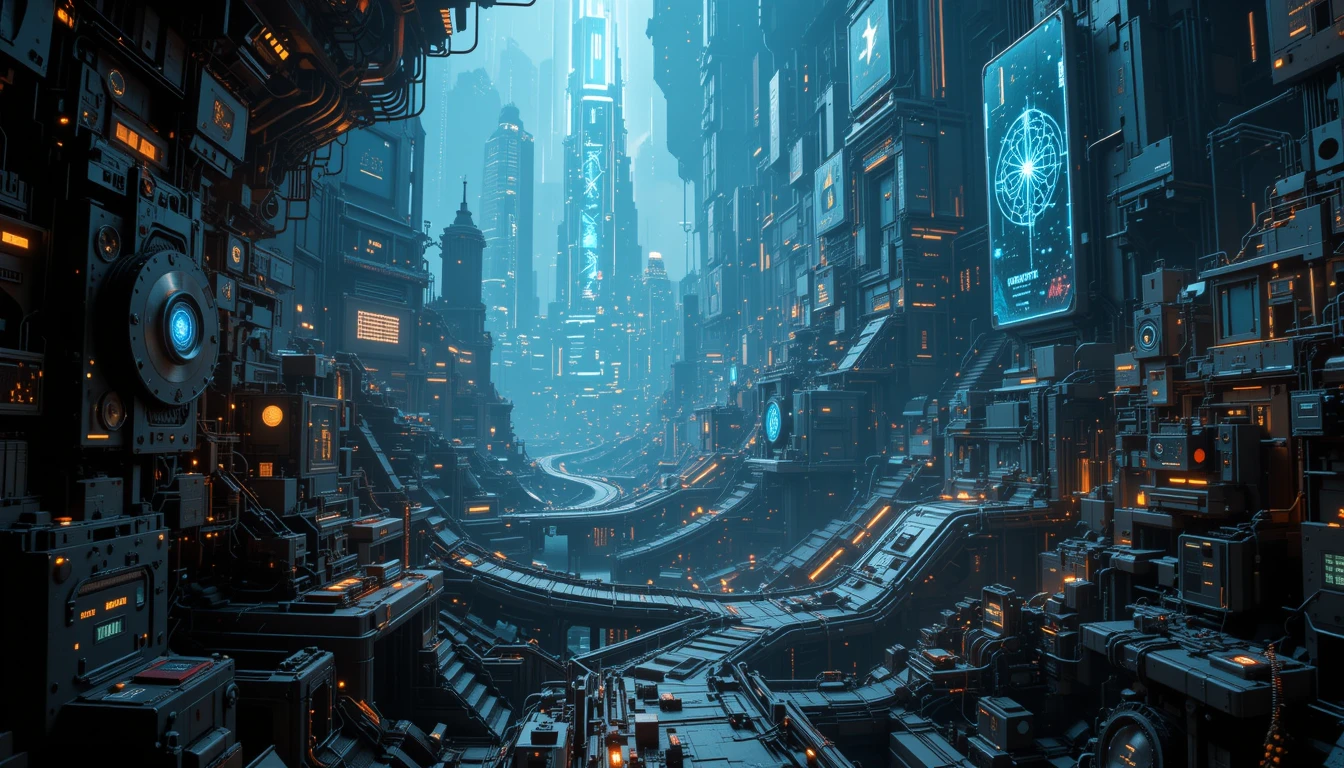
The Evolution of AI: From Origins to a Future Shaped by Innovation
AI Transformation: From Early Beginnings to a Future of Innovation
Discover AI’s journey from its 1950s origins through challenges and breakthroughs to its modern-day role in revolutionizing technology and shaping the future.
This article explores the evolution of artificial intelligence—from its roots in the 1950s to its transformative role in today’s world. Covering key milestones, groundbreaking research, and modern applications, the post provides an engaging overview of AI’s long and dynamic history. Readers will gain insights into how early ingenuity and pivotal moments led to the sophisticated AI systems that continue to reshape countless industries.
🧠 The Foundations of AI: Inception and Early Milestones
What if your brain had a turbocharged sidekick—one infused with tireless energy, lightning-fast calculations, and unending curiosity? Artificial Intelligence (AI) might seem like a futuristic fantasy, yet the truth is, this remarkable sidekick was conceived long before smartphones or self-driving cars made their mark on the world.
The inception of AI is a story rooted firmly in mid-20th-century innovation—a post-war scientific renaissance characterized by fearless imagination and boundless optimism. Far from a contemporary trend, the idea of crafting machines capable of replicating human thought originated decades ago, sparked in earnest by pioneering minds who dared to ask: Can machines think?
At the forefront of this new frontier stood John McCarthy, an American computer scientist, widely regarded as the father of artificial intelligence. It was McCarthy who, in 1956—a period when transistor radios were cutting-edge and televisions black-and-white—coined the term “artificial intelligence.” His pioneering insight not only named the captivating concept but set AI firmly in motion, paving the path for subsequent generations to explore machines that could learn, reason, and perhaps, even dream.
The same year marked a seismic shift in the AI narrative with the famed Dartmouth conference. This intellectual summit, held in the gentle embrace of Dartmouth College in New Hampshire, gathered pioneering minds including McCarthy himself—to envision a new world. This was not merely a meeting of scientists; it was AI’s Big Bang, planting seeds that would bloom into decades of relentless innovation. The Dartmouth conference underscored the ambitious yet tangible pursuit of creating machines that mirrored human intellect, set the research agenda for years to come, and crystallized an era of idealism and audacity.
During the dawn of AI exploration, the focus was unambiguous yet daunting—designing systems that embodied human-like thinking capacities. Early inventors envisioned machines that didn’t merely follow programmed instructions, but learned and reasoned independently, constantly adapting to the dynamic complexity of human cognition. Little could McCarthy and his peers have known how dramatically their vision would reshape the human experience decades later.
🚀 Decades of Progress: From Neural Networks to the AI Winter and Resurgence
By the 1960s, AI took another groundbreaking turn through neural networks—a revolutionary model inspired directly by the intricate workings of the human brain. Imagine a system composed of interconnected nodes, mimicking how neurons interact, communicate, and ultimately learn. Instead of line-by-line instruction manuals painstakingly scripted by programmers, these novel networks developed the ability to self-improve by processing data patterns and adapting through iterative experiences. It was an extraordinary pivot, transforming AI from static engineering to a dynamic, evolving discipline of computer ‘learning.’
Yet, every captivating journey includes moments of turmoil, and AI’s chronicle was no exception. As initial breakthroughs became overstated, expectations soared—and by the 1970s and onward into the 1980s, reality began to confront AI’s boundless optimism. The promised intelligence far outpaced practical results, and disillusionment seeped in. Funding dried up; investments dwindled—ushering in the chilling darkness known historically as the ‘AI winter.’ To many, this was a period of skepticism, doubt, and diminished enthusiasm, casting a pall over the once-radiant hopes of artificial intelligence.
However, the beauty in pursuing big ideas lies in both the journey and the resilience to proceed. AI’s winter would inevitably melt under the warm glow of innovation and practical problem-solving. By the late 1980s and particularly the vibrant 1990s, AI began a robust resurgence. Significant factors directly contributed—a massive data explosion aptly coinciding with dramatically advancing computational powers. Computers, once the size of entire rooms, became personal and ubiquitous—soon interlinked globally, spawning immense volumes of raw information ripe for learning algorithms.
Suddenly, AI shifted from an academic curiosity to a practical, potent force capable of solving real-world puzzles. With increased capabilities and deeper public trust, AI transitioned decisively from theoretical ideals to tangible human partners, forever altering our technological landscape.
🌐 Modern AI and Future Possibilities: Reinventing Everyday Life
Fast forward to today, and AI no longer simply consumes academic textbooks and sci-fi novels—it lives all around us, interwoven seamlessly into modern life. With the prolific spread of contemporary techniques like machine learning and deep learning, it’s clear AI isn’t just an abstract idea—it’s tirelessly working behind countless cornerstones of daily existence.
Why differentiate between machine learning and deeper relatives like deep learning? These terms map AI’s evolution clearly—machine learning enables software to “self-teach” by reinforcing patterns, while deep learning, modeled loosely on neural structures, thrives especially in complex tasks like image recognition, speech processing, and translation. With phenomenal precision, today’s sophisticated AI can sometimes outperform even human recognition and analysis, an astonishing leap from the initial rudimentary neural networks of the 60s.
Every day, AI quietly shapes our interactions and choices—whether we’re aware of it or not. Ask yourself, is that personalized Netflix recommendation a minor convenience, or a glimpse into AI’s capability to anticipate human desires? Indeed, AI-driven personalization helps tailor digital experiences uniquely to individual preferences, familiarity, and aspirations.
AI algorithms tirelessly sift through oceans of data—spotting clusters, trends, and predictions far beyond any feasible human-led analytics. Today’s data landscape is so immense, and ever-expanding, that traditional manual analysis techniques feel primitive, akin to navigating the vast ocean using nothing but a paper map. AI serves as our digital compass, guiding insight-driven decisions in finance, business intelligence, cloud computing, security protocols, and beyond.
Consider predictions, once a secure domain for fortune-tellers. AI now analyzes weather signals, anticipating shifts more accurately than ever; similarly, AI-driven financial algorithms forecast market trends with breathtaking precision, reshaping investment strategies and market understanding. Automation further revolutionizes industries, replacing repetitive tasks with intelligent efficiency and freeing human talents to focus on creative, strategic, meaningful pursuits. Smart factories exemplify this AI-powered revolution, optimizing manufacturing processes through precise, adaptive measures—a symphony of innovation, exacting efficiency, and tangible profit.
Far from constrained to corporate spaces, AI permeates essential societal sectors—healthcare, education, transportation, domestic life, and more. Picture a healthcare system where AI-enhanced diagnostics detect illnesses significantly earlier, dramatically increasing recovery odds; educational platforms enriched by personalized learning trajectories designed uniquely for each student; or driverless vehicles reshaping cityscapes, commuting, and safety.
For homes, AI promises seamless integration between our routines, desires, needs, and domestic environments. It’s more than voice-activated speakers or smart thermostats—it’s about homes intuitively supporting the rhythm of human life, adjusting dynamically, efficiently, and pleasantly to individual—and familial—rhythms.
Yet perhaps AI’s biggest impact is yet unknown. History shows technology evolves unpredictably—and massively. What undiscovered opportunities, innovations, or paradigm shifts does AI still hold? Like explorers standing at civilization’s edge, we gaze expectantly forward, sensing infinite possibilities and unprecedented advancements scarcely imagined today.
Artificial intelligence’s evolutionary story—the entrepreneurial dynamism of the mid-20th century, the frustrations of winter, the renaissance brought by computational growth, practical applications, and impactful integration—is indeed extraordinary. Yet the journey undoubtedly remains in its infancy.
At Rokito.ai, we continuously explore this panorama, committed to uncovering, interpreting, amplifying, and sharing AI’s progress. Because the future holds marvelous mysteries still unknown, tantalizing possibilities still unconceived. Humans and machines stand poised to co-create an incredible tomorrow.
Imagine—we began with a simple notion: machines imitating human intelligence. Today, we push far beyond imitation, toward genuine partnership and profound impact. The AI journey has evolved dramatically from its inception when a handful of visionaries boldly dreamt of smart machines. As we look ahead, one simple truth endures—we’ve barely begun exploring AI’s limitless frontiers. Where will the next thrilling chapter lead? Only imagination—and the bold human spirit embracing AI’s outstanding potential—can guide us from here.