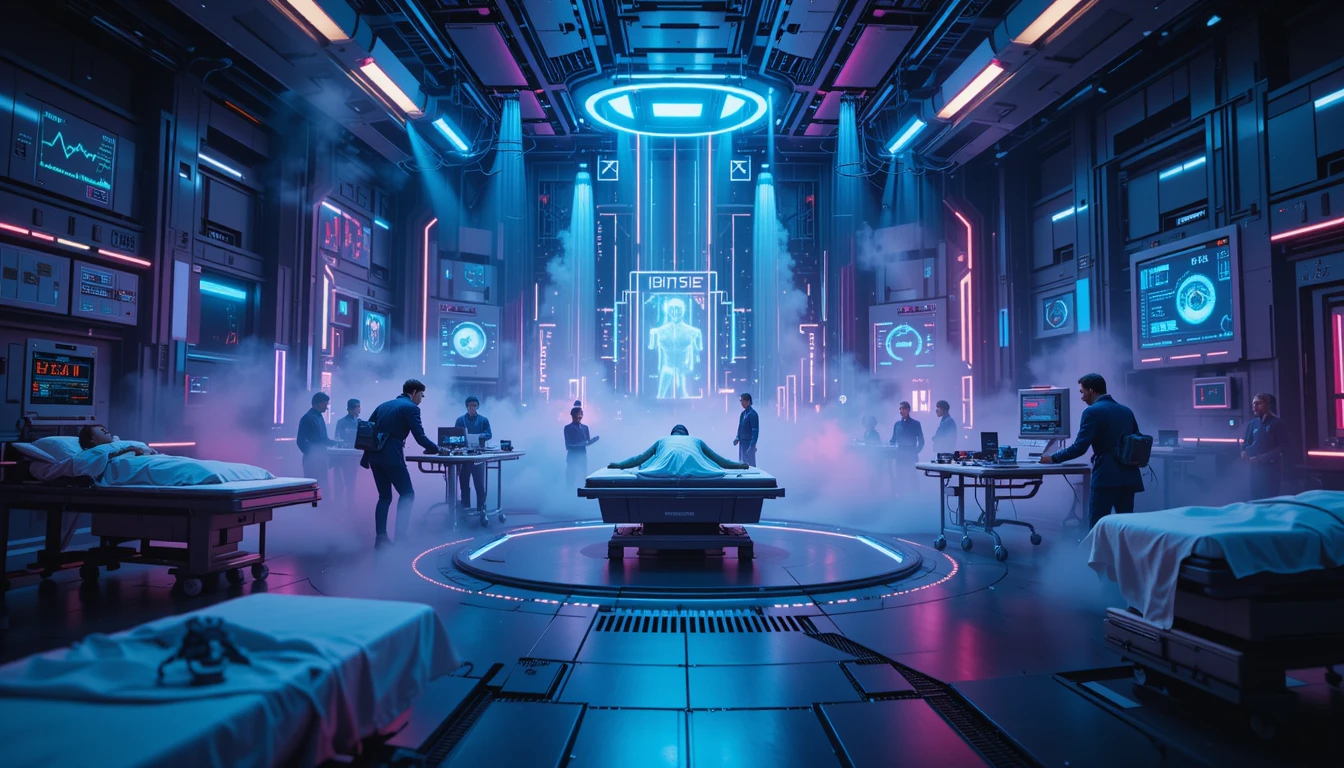
Revolutionizing Triage: Inside DARPA’s Virtual Medic Challenge
Transforming Triage with DARPA’s Virtual Medic Challenge
Discover how DARPA’s Virtual Medic Challenge is revolutionizing emergency triage with advanced virtual simulations, high-fidelity avatars, and cutting-edge technology.
This article explores DARPA’s innovative virtual competition designed to reshape mass casualty response. By leveraging realistic simulations, high-fidelity digital avatars, and sophisticated physiology modeling, the challenge sets a new standard in rapid casualty assessment. The discussion highlights breakthrough technologies and diverse team strategies that are transforming emergency response and triage in critical situations.
🚑 Understanding the Virtual Medic Challenge Landscape
In times of catastrophic incidents, one truth emerges starkly clear: time equals human lives. Mass casualty situations—a term rooted deeply in emergencies involving overwhelming injury numbers—present scenarios where the injured outnumber available medical responders. The horrific mathematics of such events is unforgiving; every second, every intervention, dramatically swings survival odds. Victims severely injured might have only a small window, mere minutes even, before passing a tragic threshold beyond life-saving help. To navigate through this, response efficiency is not just desirable; it’s paramount.
The Defense Advanced Research Projects Agency (DARPA) has recognized this critical window as a junction where advanced technology can become a genuine lifesaver. Their ongoing mission involves providing revolutionary, tech-driven methodologies that enhance medics’ response times and ensure precise decision-making even under immense emotional and operational pressure. Entering this juncture, the DARPA Triage Challenge has woven together a vision—crafting sophisticated virtual scenarios where responders must juggle multiple concurrent crises virtually indistinguishable from the chaos of reality.
Traditional medical simulation methods have long relied on live actors or human-like mannequins to inject realism into training. While valuable, these methodologies carry considerable limitations. Mannequins, despite realistic appearances, fall short in emulating complex human physiology—there’s no pulse beneath the synthetic skin or warm blood rushing through simulacrum veins. Similarly, live actors, bound by physical limitations and ethical constraints, cannot convincingly portray mortal injury. These method limitations necessitate a shift toward a digitally powered future of medical simulation.
To surpass such traditional hurdles, augmentation through virtual avatars equipped with sophisticated physiological overlays offers transformative potential. DARPA’s vision involved deploying incredibly detailed virtual humans capable of mirroring real-time physiological markers—heartbeat fluctuations, respiratory variations, severe trauma simulations. This precisely detailed mechanism integrates simulated digital insights directly on top of avatar representations, delivering visualized, quantifiable physiology, which real medics maneuvering the virtual terrain utilize for rapid, accurate triage. These hyper-realistic avatars answer the call where analog methods falter, setting an advanced standard for mass casualty incident training.
🖥️ Advanced Technologies and Simulation Tools in Triage
DARPA’s daring foray into virtualized triage spurred the creation of an extraordinary digital playground—the DARPA Triage Challenge (DTC) Virtual Platform, meticulously crafted using Unreal Engine 5. Widely revered for its cutting-edge physics realism common in AAA video game production, Unreal Engine 5 facilitates constructing believable, highly interactive scenarios. Competitors navigate richly detailed, multi-perspective environments reflective of real emergencies, like devastating train wrecks or challenging military installations, confronting complexities real-world responders encounter routinely.
At the beating heart (pun very much intended) of realism lies BioGears, a state-of-the-art human physiology modeling engine. BioGears breathes life into avatars, mimicking real-time physiological alterations—from subtle variations such as elevated heartbeats or respiration change in trauma cases—to chronic ailments exacerbating inflicted injuries. Complex interplays emerge naturally; digital persona injuries fluidly evolve with time, dynamically updating vital signs authentically, ensuring nuanced medical conditions replicate actual human responses with impressive accuracy.
To further enrich ground-breaking realism, DARPA augments casualty assessment and discovery using advanced simulated remote-sensing technologies, such as infrared vision, LiDAR, and radar. Comparable to their real-world counterparts, these sensors facilitate swift, accurate identification of casualties conceivably hidden or obscured in disaster scenarios, effectively modeling what real-life emergency response crews encounter.
Virtualized practice scenarios such as realistic civilian train crashes and military base emergencies showcase practical reflections of real-life disasters. Digital casualties replicating authentic biofeedback promise substantial benefit in diminishing uncertainty. Medics gain unparalleled intimacy and accuracy in virtual exercises, thereby elevating triage precision, strategic task prioritization, and medical response effectiveness. Crucially, digitized casualty portrayals enhance triage accuracy significantly and substantially accelerate decisive response timelines, contributing to higher survival probabilities.
🌐 Diverse Team Strategies and Competition Format
The DARPA virtual competition leverages the DTC virtual testbed to rigorously evaluate cross-disciplinary, ambitious problem-solving strategies. In multiple high-stakes virtual sessions, teams demonstrate ingenuity, leveraging leading-edge technologies to navigate rigorous simulations. Let’s analyze the distinct strategies and innovative approaches these teams pursue, revealing diverse paths leading toward effective triage solutions:
🤖 Team Coordinated Robotics
This savvy technology team employs tools like Ultralytics, sophisticated computer-vision technologies supporting object recognition, classification, and data segmentation. Integrated algorithms further convert voice inputs to text, allowing quick assessments regarding victims’ cognitive coherence, refining triage comprehensively.
🧠 Engineering Dynamics
Understanding the inherently human dimension to emergency scenarios, Engineering Dynamics’ interdisciplinary composition includes experts beyond hard sciences, extending into sociology and psychology. Rooted firmly in their belief “engineering is a ‘people problem,'” their strategy emphasizes intuitive design targeting end-user in situ needs, blending machine learning, and human behavioral analysis.
🎯 Tac Triage Technologies (TTT)
TTT’s analytical methodology employs person recognition capabilities merged with sophisticated pose detection algorithms. Detecting human avatars becomes precisely combined with vital signs derived from heart rate and respiratory analytics, efficiently extracting averaged physiologic readings critical in effective, organized triage.
✨ Team Second Sight
Expertly harnessing sensor fusion capabilities and robust algorithmic insight, Team Second Sight synthesizes machine learning insights alongside traditional algorithmic rigor. Their target: extracting complete physiological portraits for accurate identification, prioritization, and efficient triage under simulation-induced stress and chaos.
📡 Robotica
Integrating deep-seated medical knowledge within mechanical insights, Robotica iteratively produces system-generated physiological compensatory signatures. Strategically plotting optimal assessment routes efficiently covering all casualties accelerates triage assessment, crucial during vast field incidents—a practice combining medical detail with robotic agility.
🌍 International Collaboration—UASD TU
Delhi Technological University’s diverse student “Team UASD TU” exemplifies global coalition strength. Marrying disciplines spanning engineering, machine learning sophistication, cutting-edge computer science approaches, and USA-derived medical expertise, the team addresses humanitarian aid impulses, effective disaster relief provision, and efficient surveillance methodologies, underscoring broader humanitarian vision within competitive spirit.
⚙️ Family Ingenuity—Team Flying Fites
A vibrant testament to familial unity is Team Flying Fites, showcasing cohesion strengthened via integrated knowledge of engineering disciplines, foundational mathematics, physics understanding, and nuanced pharmacy-based perspectives. The outcome blends interpersonal relationships and professional acumen into streamlined competitive edge—a distinctive approach in complex challenges.
DARPA’s scoring architecture fairly benchmarks individual performance across demanding iterative runs, utilizing aggregated average scores to holistically measure capability and reliability. Teams navigate simulated environments repeatedly, evolving adaptive strategies built on successive improvement and iterative learning. This balanced approach ensures fairness, robustness, and comprehensive team evaluations amidst virtualized competitive pressures.
Through researchers’ and engineers’ diverse strengths, DARPA’s novel competition underlines invaluable collaboration, extending knowledge frontiers and practically revolutionizing emergency triage responses worldwide. These collective strides toward digital realism—infused with rigorous analytical robotics, machine learning insight, and unprecedented human-centric modeling —might indeed represent humanity’s pinnacle in artificial-powered resilience, forever reshaping our preparedness against high-stakes crises.