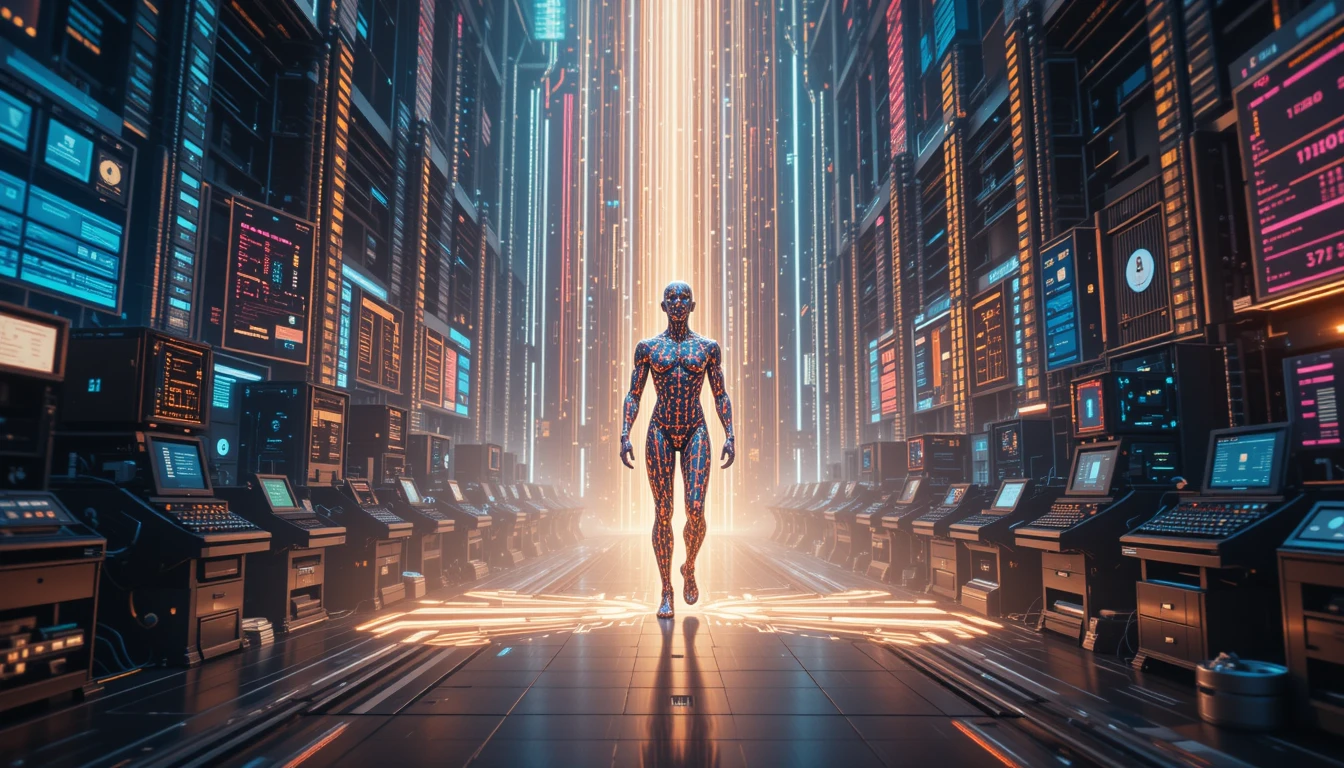
AI Uncovered: From 1950s Origins to World-Changing Power
AI Exposed: 1950s Roots to Global Innovation
Discover the evolution of AI from its 1950s beginnings to its transformative impact today, exploring milestones, breakthroughs, and future possibilities.
This article explores the dynamic journey of artificial intelligence—from its inception in the 1950s to its current role as a global catalyst for change. It highlights key historical milestones, breakthrough innovations, and the expanding influence of AI in everyday life. Readers will uncover how AI evolved from early theoretical concepts into a driving force behind modern technology, emphasizing its practical applications and the limitless potential ahead.
🧠 Foundations of Artificial Intelligence
For many, artificial intelligence evokes images straight out of Hollywood—sentient robots and talking computers seamlessly integrating into our lives. Yet, in reality, the kernel of AI was planted well before AI found its way onto movie screens. As early as the mid-20th century, researchers began exploring the idea of creating machines intelligent enough to mirror human thought processes. While modern AI conjures thoughts of cutting-edge gadgets and algorithms, its foundations were laid decades ago in labs filled with ambitious researchers, curious to unlock the secret to simulating human cognition.
AI—which today permeates almost every aspect of our daily experience—was formally defined and named by John McCarthy, an influential computer scientist, in 1956. McCarthy was a visionary whose pioneering work ignited decades of innovation, laying foundational ideas whose echoes still reverberate across today’s digital landscape. His introduction of the term “artificial intelligence” catalyzed a series of explorations into computer-based intelligence, motivating collaboration, debate, and discovery.
In the same pivotal year, 1956 also witnessed the historically momentous Dartmouth Conference—a landmark event convening a dynamic group of scientists, mathematicians, and pioneering minds. The conference marked the commencement of formalized AI research, as these visionaries pondered the feasibility of creating machines capable of emulating human cognitive capabilities. What was initially seen as an experimental idea soon came to define a whole new field of study and innovation. It planted the seed for AI’s exponential growth, turning aspirations into relentless scientific pursuit, with goals that included enabling machines to learn, adapt, reason, and even eventually surpass human intelligence in select tasks.
Early ambitions in this emerging field centered largely on imitating human cognition—machines that could perform basic reasoning, problem-solving, and even understand natural language. Initially, these aspirations bordered on pure audacity. Yet, as ambitious as these early objectives were, they encapsulated the fascinating blend of bold vision and calculated experimentation that defines AI as we understand it today.
❄️ Pioneering Milestones and the AI Winter
Throughout its history, AI has oscillated through distinct cycles of enthusiastic optimism and sobering skepticism. In the 1960s, one of the groundbreaking developments was the inception of neural networks—systems modeled after the densely interconnected workings of the human brain. These early neural networks weren’t just lines of code executing pre-defined tasks; they were designed to learn autonomously from input experiences, marking a significant shift from manual programming to experiential learning.
However, AI’s progress was not linear. By the 1970s and 80s, the early excitement had outstripped capabilities, plunging AI research into what became known as the AI winter—a period marked by diminished funding, skepticism, and catalytic introspection. Ambitious predictions had failed to materialize, investor confidence waned sharply, and the public grew disillusioned with AI’s overstated promises. Despite advances, computing resources still lagged far behind researchers’ bold aspirations, leading to a hiatus of sorts in widespread groundbreaking advancements.
Yet, this challenging phase proved crucial in shaping AI’s future trajectory. The AI winter brought invaluable lessons: the importance of calibrating expectations, balancing ambition with practical applicability, and prioritizing tangible, measurable outcomes. It underscored the necessity for rigorous methodologies, realistic goal-setting, and a stronger alignment between hype and actual capabilities. Ultimately, these critical learnings paved the way toward smarter, steadier, and more sustainable progress.
🚀 Modern-Day AI: Applications and Impact
By the 1990s, AI’s fortunes experienced a dramatic revitalization, driven largely by two critical factors: the explosion of data and an unprecedented leap in computing power. Together, these elements provided fertile ground for algorithms capable of handling massive data quantities effectively. AI research was no longer restricted to theoretical constructs; it evolved into a critical practical tool addressing tangible, complex, and relevant global challenges.
One major shift came via advances in machine learning—a subset of AI emphasizing systems’ capacity to learn autonomously from data without needing explicit programming. A further progression, deep learning, revolutionized diverse fields, notably image and speech recognition. AI-driven deep learning surpassed human-level accuracy in various applications, from facial recognition to natural language processing— reshaping our interactions and technological experiences in unexpected, profound ways.
Today, AI is omnipresent in our daily lives and integrated into numerous industries:
-
Data Analysis: AI algorithms methodically pore through extensive datasets, revealing complex patterns and valuable insights humans might otherwise miss, aiding strategic business decisions and enhancing forecast accuracy.
-
Automation: AI takes responsibility for repetitive, often tedious tasks, thus enabling human talent to focus on more strategic, complex, and creative roles. Robotic automation, manufacturing advances, and smart factories now signify industrial transformation, made possible by cohesive human-AI collaborations.
-
Personalized Experiences: AI is fundamentally changing user interactions—algorithm-powered recommendations dominate platforms like Netflix, Spotify, and e-commerce websites, offering users curated and personalized experiences.
This transformative landscape showcases a more mature AI landscape—one that’s actively reshaping businesses, lifestyles, and even societal behaviors.
🌌 The Limitless Future of AI
AI’s journey—from ambitious origins to today’s powerful applications—is far from complete. We’re now standing on the cusp of another transformative era, characterized by continued AI integration, expanded computational capabilities, and an entirely new set of evolving possibilities.
Across virtually every sector—healthcare, education, transportation, the arts, and beyond—AI’s potential continues expanding exponentially, redefining what’s possible. In healthcare, AI-powered systems actively enhance diagnostic accuracy, optimize treatment plans, and predict patient outcomes, addressing previously intractable challenges. Education increasingly leverages AI tools to personalize learning journeys, identify areas requiring improvement, and upgrade overall teaching efficiency. Meanwhile, transportation is bracing for dramatic transformations, from self-driving vehicles to sophisticated traffic optimization algorithms promising safer, infinitely more efficient journeys.
AI-powered predictive models currently surpass human analysts in recognizing patterns and making meaningful forecasts. Weather prediction technologies benefit from advanced AI methodologies handling enormous meteorological datasets effectively, directly transforming response efficiency and emergency preparedness. Likewise, in finance and market analytics, AI-driven predictive analysis is contributing to strategic investment decisions, forecasting market movements with remarkable precision, and enhancing risk reduction.
Continuous innovation and increased computational power promise to further accelerate AI’s global impact and scalability. Next-generation quantum computing, improved computational infrastructures, and sophisticated edge-computing paradigms will amplify AI capabilities significantly, profoundly influencing all aspects of technology and society.
Looking ahead, the transformative potential of AI remains as limitless as ever. The trajectory is clear—a continuous evolution towards even more inventive, intelligent technologies enhancing human capability. AI is no longer merely an intriguing concept in research labs or a sophisticated tool in leading industries. Rather, it represents a fundamental component woven intricately into humanity’s ongoing narrative, promising more efficiency, intelligence, and creativity in every human endeavor.
Yet, as profound these advancements are, equally critical is the responsibility humanity holds in shaping AI’s future development ethically and inclusively. As AI continues to write the next chapters of human civilization and technological progress, the collaborative partnership between humankind and intelligent machines promises a future transformed, limitless in possibility, and richer in potential than our predecessors could have dreamed.
In essence, understanding AI’s foundational roots, recognizing its evolving trajectory, and preparing ourselves proactively for future developments position us strategically to harness its potential fully. From an imaginative concept birthed nearly a century ago, artificial intelligence has evolved into an unprecedented technological ecosystem destined to redefine every aspect of our lives, connections, and societal structures in the coming decades. The era of AI is now firmly upon us—and its continued evolution promises thrilling, unprecedented possibilities that we are just beginning to envision.