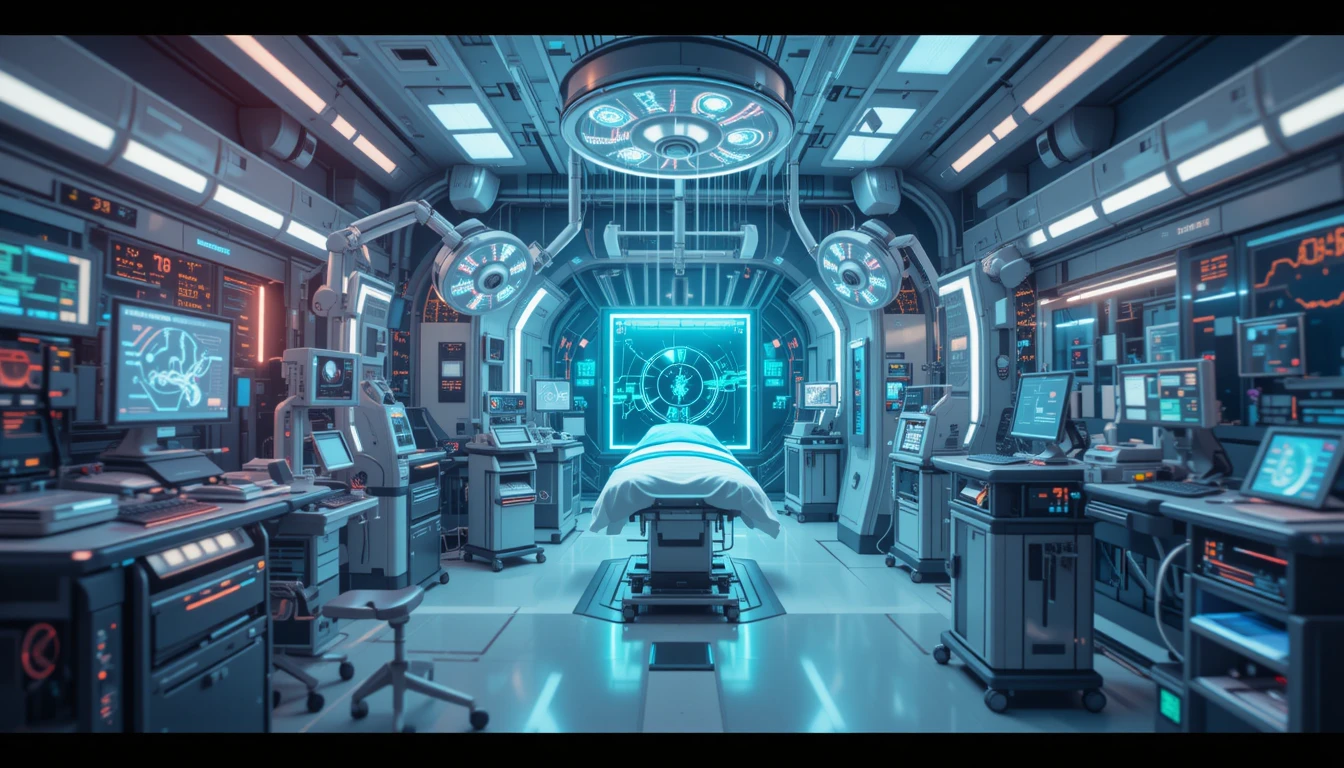
AI Breakthroughs in Trauma Care Predict Life-Saving Interventions
AI Advances in Trauma Care: Predicting Critical Interventions
Explore how AI-driven algorithms enhance trauma care by predicting life-saving interventions and revolutionizing prehospital triage.
This article examines the revolutionary role of AI in trauma care. It delves into how advanced algorithms are designed to anticipate life-saving interventions in mass casualty situations. By understanding the challenges of rapid triage and the integration of multimodal medical data, readers gain insights into innovative solutions that can transform emergency response and clinical outcomes.
🚑 Challenges in Trauma Care and Triage
Imagine the scene: a battlefield or a bustling urban street corner, suddenly transformed into a chaos-filled trauma situation. “Mass casualty” paints an intense picture—it’s any time the number of casualties overwhelms the immediate response capabilities of medics. Seconds become the dividing line between life and death, and immediate intervention becomes paramount. Daunting? Certainly. But solvable through technology? Absolutely. Today, the average medic’s response time during a large-scale trauma event is severely constrained. With limited personnel dealing simultaneously with multiple critically injured patients, many casualties risk deteriorating irreversibly if left untreated within just a few precious minutes.
Two of the gravest threats in such situations—hemorrhaging and airway injuries—demand swift detection and immediate life-saving intervention. Without prompt attention, these conditions escalate rapidly, often resulting in preventable fatalities. The brutal truth is that humans alone can’t analyze multiple casualties simultaneously, let alone rapidly assimilate fragmented and chaotic data flows from injury sites. This is precisely where artificial intelligence can become a linchpin. By aggregating electronic health records (EHRs), sensor-generated data, and noisily fragmented, real-world medical signals from the chaotic battleground of trauma, AI emerges as humanity’s trusted co-pilot. AI isn’t merely a tool; it’s a critical co-creator of life-saving outcomes. Ready to explore how technology is revolutionizing the medic’s toolkit?
🤖 Developing AI Algorithms for Life-Saving Intervention Prediction
To transform chaos into clarity at disaster sites, DARPA has provided unparalleled resources—de-identified multimodal physiological data encompassing diverse trauma patients. These datasets, sourced from the esteemed Shock Trauma Centers at the University of Maryland, Baltimore, and the University of Pittsburgh Medical Center, contain crucial insight from both prehospital situations (where injury first occurs) and in-hospital care scenarios. This integration provides an exceptional breadth and depth to train predictive AI algorithms accurately.
Teams are tasked with creating predictive models that tap into this rich trove of data to detect early signatures necessitating crucial medical interventions. Imagine an algorithm alerting a medic about imminent airway failure or uncontrollable hemorrhaging, precious moments before overt clinical signs appear. The predictive capabilities hinge upon machine learning’s ability to read between the lines of raw physiological measurements like waveform data from patient monitors, heart rate signals, electronic health records, and fragmented medical notes.
But meaningful prediction goes far beyond mere technical prowess. Algorithms must function reliably in noisy, real-world environments suffering from sensor data dropout and signal degradation—conditions common during crises. Understanding the insights hidden amidst this challenging medical data tapestry demands robust AI training under validated metrics of sensitivity (detecting actual critical cases), specificity (avoiding false alarms triggering unnecessary interventions), and computational speed (ensuring timely, actionable diagnostics).
Combining raw medical sensor streams with rich contextual data (such as medical history and procedure logs) significantly enhances the efficiency of predictive algorithms and decision support outcomes. This is the future of trauma and triage transformed.
🛠️ Leading Teams and Their Innovative Approaches
The response from the cutting-edge AI community has been nothing short of phenomenal, showcasing impressive, novel methodologies and paradigm-shifting strategies.
Team CRITIC: Integrated Battlefield Innovations
Leveraging experience from battle-tech, Team CRITIC (Continuous Review and Intervention for Timely Care) stands out with an ambitious design—a comprehensive end-to-end machine learning approach, meticulously integrating real-time sensor signals with medical context. Rather than isolated evaluations, their solution unifies battlefield-readiness with predictive modeling to produce actionable, life-saving insights instantly.
Team Coordinated Robotics: Precise Data Artisanship
Drawing inspiration from precision robotics, their methodology emphasizes rigorous data selection, meticulous cleaning, and nuanced modeling, verified exhaustively against ground truths. They demonstrate the importance of disciplined accuracy at every stage—underscoring that AI precision is never incidental but painstakingly engineered.
Team MSAI: Addressing Data Imbalances Statistically
As is often encountered in clinical scenarios, imbalanced clinical datasets posed unique challenges. Team MSAI adeptly overcame this by judiciously applying statistical methodologies and machine learning models to focus computational resources and prediction accuracy on critical minority classes—optimizing their model for rapid deployment.
Team AI Tempo: Mastering Incomplete Data Fusion
AI Tempo tackled arguably one of the most enigmatic problems: how to reliably predict life-saving interventions using incomplete, partially overlapping data. By fusing raw, expert-derived, and data-generated feature arrays, coupled with innovative post-hoc feature importance ranking and pre-training selection—AI Tempo epitomizes the elegance of strategic simplification.
Team MGB Harvard: Cutting-Edge Neural Architectures
Bringing academic rigor from Harvard, Team MGB employed advanced neural network training, employing multiple tokenization schemes across vital signs and sensor data. Their meticulous hyperparameter tuning and model selection for intervention-specific scenarios demonstrates the potential of academic research in clinical applications.
Team LENS: Early Notification Excellence and Generalizability
The Life-saving Intervention Early Notification System, or LENS, utilized statistical sensory modeling and hybrid AI/ML methods to provide early detection and robust clinical predictions. Their forthcoming phase strategically focuses on enhancing the generalizability of models by combining multidisciplinary data across institutions—critical to wider clinical implementation.
Team Robotica: Structured Machine Learning Pipelines
This team championed structured, systematic operations—first selectively removing compromised or erroneous data and then methodically building optimized models. Their disciplined approach highlights that success in AI doesn’t necessarily require complexity; sometimes, meticulous groundwork pays the highest dividends.
Team True Fit AI: Strong Feature Engineering
True Fit AI stands out with its aggressive feature engineering initiatives, shaping datasets encompassing hundreds of engineered features from raw data. With robust cross-learning strategies using gradient-boosted trees and versatile parallel neural inference methods, their solution consistently delivered high predictive accuracy.
🌐 Future Directions in AI-Enhanced Trauma Data Analytics
This competition is just the beginning. The future promises astonishing potential by incorporating advanced biometric signals previously undreamt-of in standard clinical practice. For instance, advanced data types including pupillometry (examining pupils’ reactive regulation as indicative of neurological injury), ventilator management data, and targeted tissue oximetry readings (for precise oxygenation diagnostics) stand to dramatically improve predictive algorithms’ sophistication and clinical relevance.
Expanded data types will undoubtedly revolutionize models’ capabilities, elevating predictive accuracy and empowering medics with even greater foresight. Envision the transformative difference for first responders equipped by AI-enabled wearable sensors instantly interpreting pupillary changes or early oxygen deprivation signs—allowing precious minutes of anticipatory intervention.
Yet, beyond immediate technological leaps, these AI advancements hold enormous long-term societal benefit. Prehospital care and hospital-based trauma protocols could see profound shifts, driven by intelligent algorithms enhancing real-time triage, guiding personalized interventions, and significantly reducing avoidable mortality and morbidity.
A tightly-woven collaboration between trauma care facilities and pioneering AI research institutes will form the backbone of this future medical renaissance. Shared insights, iterative research, multi-institutional data compilation, and coordinated enhancement of methodologies will foster innovations that revolutionize emergency responsiveness, trauma care, and clinical effectiveness at scale.
🤔 Quick Check-In
- What immediate impacts can predictive AI algorithms have on trauma care in your community?
- How do you envision collaborative efforts unfolding between AI researchers and medical professionals to shape trauma responses?
❓ FAQ
Will AI replace frontline medics in trauma situations?
Not at all—AI platforms will amplify human efficacy and capability, augmenting triage accuracy, efficiency, and speed so that medics become more empowered, rather than replaced.
How realistic are these technologies for widespread adoption?
They’re eminently realistic and becoming increasingly feasible, particularly given DARPA’s rigorous validation standards. The inclusion of reputable trauma centers and real-world clinical cohorts underscores this realism.
Insert Graph: “Comparison of Intervention Prediction Accuracy Before and After AI Integration (2025-2030)”
Deeper insights, data richness, and strategic partnership between trauma professionals and artificial intelligence teams are not just exciting—they’re life-saving. At Rokito.ai, we’re standing at the forefront of this technology, committed to ushering in a future where AI and humans co-create enhanced trauma care. Imagine the possibilities.